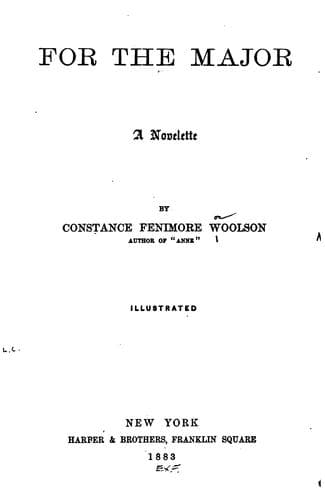
For the Major: A NoveletteWoolson, Constance Fenimore
General
For the Major: A Novelette
Woolson, Constance Fenimore
Psychological fiction; United States -- Social life and customs -- 19th century -- Fiction
"What's that thing they're trying now?" said this official, abandoning
his jocularity. "Dull and see-saw it sounds to me; dull and see-saw."
"It's a _Te Deum_ I selected for Trinity Sunday."
"Ah, if _you_ selected it--But it can never equal 'old Jackson's,'
never! That's Sophy Greer on the solo. She can no more do it than a
consumptive hen. But, sir, I'll tell you who can--Sara Carroll. They
expect her home to-night."
"Madam Carroll's daughter?"
"No, the Major's. Madam Carroll is the Major's second wife--didn't you
know that? Sara Carroll, sir, can never hope to equal her step-mother in
beauty, grace, or charm. But she is a fine girl in her way--as indeed
she ought to be: her mother was a Witherspoon-Meredith."
The rector looked unimpressed. The junior warden, seeing this, drew up
his chair. "The Witherspoon-Merediths, Mr. Owen, are one of our oldest
families." (The rector resigned himself.) "When Scarborough Carroll
married the beautiful Sara of that name, a noble pair they were, indeed,
as they stood at the altar. I speak, sir, from knowledge: _I_ was
_there_. Their children--two boys--died, to their great grief. The last
child was this daughter Sara; and the accomplished mother passed away
soon after the little thing's birth. Sir, Major Carroll, your senior
warden, has always been one of our grandest men; in personal appearance,
character, and distinguished services, one of the noblest sons of our
state. Of late he has not, perhaps, been _quite_ what he was physically;
but the change is, in my opinion, entirely due--entirely--to his own
absurd imprudences. For he is still in the prime of life, the very
prime." (Major Carroll was sixty-nine; but as the junior warden was
eighty-five, he naturally considered his colleague still quite a boy.)
"Until lately, however, he has been undeniably, I will not say one of
nature's princes, because I do not believe in them, but one of the
princes of the Carrolls, which is saying a vast deal more. His little
girl has always adored him. He has been, in fact, a man to inspire
admiration. To give you an idea of what I mean: a half-brother of his,
much older than himself, and broken in health, lost, by the failure of a
bank, all he had in the world. He was a married man, with a family.
Carroll, who was at that time a young lieutenant just out of West Point,
immediately shared his own property with this unfortunate relative. He
didn't dole out help, keeping a close watch over its use, or grudgingly
give so much a year, with the constant accompaniment of good advice; he
simply deeded a full half of all he had to his brother, and never spoke
of it again. Forty-five years have passed, and he has never broken this
silence; the brother is dead, and I doubt if the children and
grandchildren who profited by the generous act even know to whom they
are indebted. Such, sir, is the man, chivalrous, unsullied, true. In
1861 he gave his sword to his state, and served with great gallantry
throughout the war.
Public-domain text, read in full here on John Shaqi.
Reviews
Reviews
No reviews yet
Be the first to share your thoughts on this work.
Join the Discussion
Join the discussion
Sign in to leave a comment or review.
Sign InorCreate an account