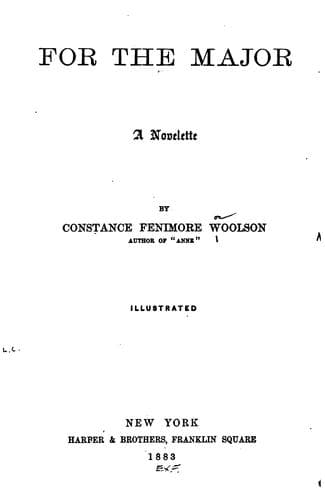
For the Major: A NoveletteWoolson, Constance Fenimore
General
For the Major: A Novelette
Woolson, Constance Fenimore
Psychological fiction; United States -- Social life and customs -- 19th century -- Fiction
The creed was ancient--both towns boasting an ante-Revolutionary
origin--but, though ancient, Madam Carroll of the Farms had been the
first to embody it in a portable phrase; brief (for more words would
have given too much importance to the subject), calmly superior, as a
Carroll phrase should be. Madam Carroll had remarked that Edgerley
seemed to her "commercial." This was excellent. "Commercial!" Nothing
could be better. Whatever Far Edgerley was, it certainly was not that.
Madam Carroll of the Farms, upon a certain evening in May, 1868, was
sitting in her doorway, her eyes fixed upon the dull red line of a road
winding down the mountain opposite. This road was red because it ran
through red clay; and a hopelessly sticky road it was, too, at most
seasons of the year, as the horses of the Tuloa stage line knew to their
cost. But the vehicle now coming through the last fringes of the firs
was not a stage; and it was drawn, also, by two stout mules that
possessed a tenacity of purpose greater even than that of red clay. It
was the carriage of Major Carroll of the Farms, Far Edgerley, and at the
present moment it was bringing home his daughter from the western
terminus of the railway.
A gentleman's carriage drawn by mules might have seemed something of an
anomaly in certain localities farther eastward. But not here. Even
Edgerley regarded this possession of its rival with a respect which
included the mules, or rather, which effaced them in the general aroma
of the whole, an aroma not actual (the actual being that of ancient
leather not unacquainted with decay), but figurative--the aroma of an
undoubted aristocracy. For "the equipage," as it was called, had
belonged to the Carrolls of the Sea Islands, who, in former days of
opulence, had been in the habit of spending their summers at the Farms.
When their distant cousin, the Major, bought the Farms, he bought the
carriage also. This was as well. The Sea Island Carrolls had no longer
any use for a carriage. They had not even mules to draw it, and, as they
lived all the year round now upon one of their Sea Islands, whose only
road through the waste of old cotton-fields was most of the time
overflowed, they had nothing to draw it upon; so the Major could as well
have the benefit of it. This carriage with its mules now came into sight
on the zigzags of the mountain opposite; but it had still to cross the
lower valley, and climb Chillawassee, and night had fallen before the
sound of its wheels was heard on the little bridge over the brook which
crossed what was called Carroll Lane, the grassy avenue which led from
Edgerley Street up the long knoll to Carroll Farms.
Public-domain text, read in full here on John Shaqi.
Reviews
Reviews
No reviews yet
Be the first to share your thoughts on this work.
Join the Discussion
Join the discussion
Sign in to leave a comment or review.
Sign InorCreate an account