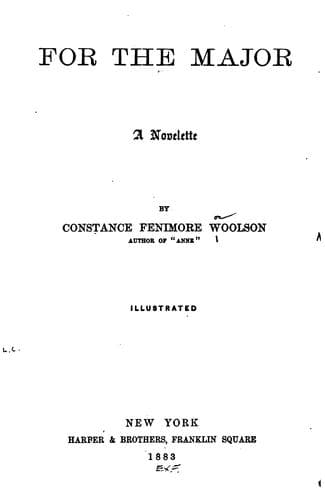
For the Major: A NoveletteWoolson, Constance Fenimore
General
For the Major: A Novelette
Woolson, Constance Fenimore
Psychological fiction; United States -- Social life and customs -- 19th century -- Fiction
"No," answered Madam Carroll, with the same measured utterance; "the
Major must not be troubled, his comfort must always be first. But as he
is generally tired on Sunday evenings, perhaps he will go to bed early.
I must wait, in any case, until he is asleep."
"Mamma, you cannot bear it," urged Sara, following her.
"Instead of saying that, you should tell me if there is hope--hope that
I may not be too late," said Madam Carroll almost sternly, putting aside
the girl's outstretched hands.
"I think he may not--they said he would not--Mrs. Walley said, 'He will
pass at dawn,'" answered Sara, using the mountain phrase.
"I may then be in time," said Madam Carroll, in the same calm voice. She
turned the handle of the door. "You had better join us soon. Your father
has been asking for you." She went in, closing the door behind her.
When Sara entered, fifteen minutes later, she found her singing the
evening hymn to the Major. The Major liked to have her sing that hymn on
Sunday evenings, and Scar liked it too, because he could join in with
his soft little alto.
"The day is past and gone,
The evening shades appear;
O may we all remember well
The night of death draws near,"
sang the wife, in her sweet voice, sitting close to her husband's chair,
so that he could hear the words.
Not long afterwards the Major said he was tired; it was not often that
he was tired so early in the evening, but to-night, for some reason, he
felt quite weary; he thought he would go to bed. It was half-past eight;
at nine he and Scar were both asleep, and the two women left the house
together. Walley's Cove was not far from the Farms, but it was farther
up the mountain, where there was no road, only paths; they could not,
therefore, go in the carriage; they could have taken Caleb Inches with
them, but in that peaceful neighborhood escort for mere safety's sake
was not necessary, and they preferred to be alone.
"Take my arm, mamma," said Sara, as they began to ascend.
But Madam Carroll would not. She walked on unaided. Her step was firm.
She did not once speak.
In the small room under the roof, which he had occupied since his
return, lay the young man who was now dying; for it needed but one
glance to show that the summons had come: he was passing away. The
farmer's wife, much affected, knelt beside him; the doctor had gone, she
said, but a short time before; there was nothing more that he could do,
and he was needed elsewhere. The farmer himself was fanning the
unconscious face. Madam Carroll took the fan.
"Let me do that," she said. "I know you feel as if your children were
needing you down-stairs."
Public-domain text, read in full here on John Shaqi.
Reviews
Reviews
No reviews yet
Be the first to share your thoughts on this work.
Elsewhere in the archive
Join the Discussion
Join the discussion
Sign in to leave a comment or review.
Sign InorCreate an account