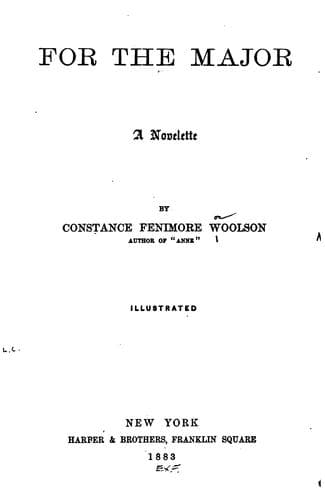
For the Major: A NoveletteWoolson, Constance Fenimore
General
For the Major: A Novelette
Woolson, Constance Fenimore
Psychological fiction; United States -- Social life and customs -- 19th century -- Fiction
For the three little children had been left alone in the room below,
and, disturbed by the absence of father and mother, were not asleep; one
of them had begun to cry a little at intervals. The farmer went down,
his clumsy boots making no sound on the uncarpeted stairway, so careful
was his tread. Madam Carroll sat down on the edge of the poor bed, and
fanned the sleeping face; the eyes were closed, the long, dark lashes
lay on the thin cheeks, the breath came slowly through the slightly
parted lips. The farmer's wife began to pray in a low voice; she was a
devout Baptist, and she had had her pastor there in the afternoon, and
had fancied that the dying man was conscious for a time, and that he had
listened and responded. She had grown fond of the poor musician in
taking care of him, and the tears rolled down her sunburned cheeks as
she prayed. Madam Carroll remained calm; she moved the fan with even
sweep to and fro. She had taken off her bonnet, as the night was warm,
and with her golden curls, her pink-tinted complexion, and the same
pretty dress she had worn to church in the morning, she was a contrast
to the rough, bare room, to the farmer's wife, in her coarse homespun
gown, and even to her own daughter, who, in her plain black dress, her
face pale and sad, was standing near.
An hour passed. The child's wail below had now in it the unmistakable
sound of suffering. "Pray go down," said Madam Carroll; "I am sure your
baby needs you."
"But I don't like to leave you, Madam Carroll; it doesn't seem right,"
the woman answered, yet listening, too, at the same time, to the baby's
wail below.
"You need have no hesitation. I have had experience of this kind before;
and besides, I do not easily lose my self-possession."
"Yes, you _hev_ got a strong hold on yersel," said the farmer's wife
admiringly. They spoke in low tones, though sounds of earth could no
longer penetrate to that gray, still border-land which the sleeper's
soul was crossing. "I know you keer for the poor young man; you keer
for him as much as I do. For yer see he ain't got no mother to be sorry
for him, poor fellow," she continued, laying her rough hand tenderly on
his head; "and you and me knows, Madam Carroll, how his mother'd feel.
There ain't nothing like the way a mother keers for her boy."
Sara came forward. "I am sure your child needs you, Mrs. Walley," she
said; "please go down at once. I promise to call you if anything should
be needed."
The child was crying again, and the mother went. Sara softly closed the
door. It had not been closed until then.
Public-domain text, read in full here on John Shaqi.
Reviews
Reviews
No reviews yet
Be the first to share your thoughts on this work.
Elsewhere in the archive
Join the Discussion
Join the discussion
Sign in to leave a comment or review.
Sign InorCreate an account