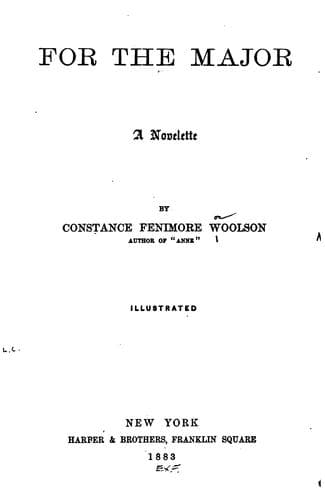
For the Major: A NoveletteWoolson, Constance Fenimore
General
For the Major: A Novelette
Woolson, Constance Fenimore
Psychological fiction; United States -- Social life and customs -- 19th century -- Fiction
But a presence is more than an absence. Absent as were all signs of age
in Madam Carroll, as present were all signs of youth in the daughter who
had just arrived. Sara Carroll was barely twenty. She was tall and
slender; she carried herself well--well, but with a little air of pride.
This air came from the poise of her head: it was as noticeable when one
saw her back only as when one saw her face. It seemed a pride personal,
not objective, belonging to herself, not to her surroundings; one could
imagine her with just the same air on a throne, or walking with a basket
on her arm across a prairie. But while it was evident that she was
proud, it would have been difficult to have stated correctly the nature
of the feeling, since it was equally evident that she cherished none of
the simple little beliefs often seen in girls of her age before contact
with the world has roughly dispelled them--beliefs that they are
especially attractive, beautiful, interesting, winning, and have only to
go forth to conquer. But she herself could have stated the nature of it
confidently enough: she believed that her tastes, her wishes, her ideas,
possessed rather a superior quality of refinement; but far beyond this
did her pride base itself upon the fact that she was her father's
daughter. She had been proud of this from her birth. Her features were
rather irregular, delicate. Ordinarily she had not much color. Her
straight, soft thick hair of dark brown was put plainly back from her
oval face, and this face was marked by the slender line of eyebrows of
the same dusky hue, and lighted by two gray eyes, which were always, in
their fair, clear color, a sort of surprise when the long, dark lashes
were lifted.
"I wonder that you take the trouble," she said, referring to the
proposed reception.
The blue orbs of Madam Carroll dwelt upon her for a moment. "We must
fill our position," she answered. "We did not make it; it has been
allotted to us. Its duties are therefore our duties."
"But are they real duties, mamma? May they not be fictitious ones? If we
should drop them for a while--as an experiment?"
"If we should drop them," answered Madam Carroll--"if we should drop
them, Far Edgerley, socially speaking, would disappear. It would become
a miscellaneous hamlet upon a mountain-top, like any other. It would
dissolve into its component parts, which are, as you know, but ciphers;
we, of the Farms, hold them together, and give them whatever importance
they possess."
"In other words, we, of the Farms, are the large figure. One, which,
placed before these poor ciphers, immediately turns them into wealth,"
said Sara, laughing. "Precisely. The receptions are part of it. In
addition, the Major likes them."
Sara's eyes left the soft darkness of the garden, and rested upon the
speaker. "If my father likes them, that is enough. But I thought he did
not; he used to speak of them, when we met at Baltimore, as so
wearisome."
Public-domain text, read in full here on John Shaqi.
Reviews
Reviews
No reviews yet
Be the first to share your thoughts on this work.
Join the Discussion
Join the discussion
Sign in to leave a comment or review.
Sign InorCreate an account