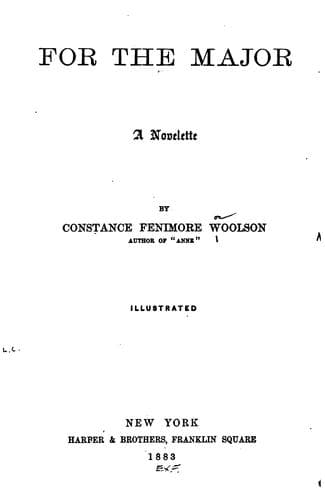
For the Major: A NoveletteWoolson, Constance Fenimore
General
For the Major: A Novelette
Woolson, Constance Fenimore
Psychological fiction; United States -- Social life and customs -- 19th century -- Fiction
"Oh, dear Mrs. Hibbard, surely we should be charitable," said little
Miss Tappen, who was waiting with a wreath of her best chrysanthemums to
place upon the completed mound.
"Well, Amelia, can you say he _had_?" said the General's widow, in an
argumentative tone, with her forefinger extended.
"I suppose he had neither father nor mother, nor any near relatives,
poor fellow, as he never spoke of them," observed Miss Dalley; "that is,
I never heard that he did. But perhaps he talked more freely to you,
Madam Carroll. Did he ever mention his parents?"
"Mamma, I think we had better go now," interposed Sara Carroll. "You are
very tired, I know."
"Oh, yes," said all the ladies, "do go, dear Madam Carroll." "You have
had so much to do lately." "You are looking quite fatigued, really."
"Pray take care of yourself, for all our sakes."
Madam Carroll looked at the mound, which was now nearly completed. Then
she made a little gesture of farewell to the group, and turned with her
daughter towards the gate. All the ladies wore black dresses: it was the
custom at Far Edgerley to wear black at funerals. Madam Carroll not
only wore a black dress, but she had put a black ribbon on her little
straw bonnet.
"Isn't it sweet of her to do that?" said Miss Dalley. "It makes it a
sort of mourning, you know; and I like to think that the poor lonely
fellow had at least one mourner to stand beside his grave."
The path took the two ladies past the study. Its door was open; the
rector saw them, and came out. He offered his arm in silence to Madam
Carroll. She took it. She was trembling a little. "I am excessively
tired," she said, as if apologizing.
"Yes, I noticed it during the prayer."
"Then you were there?" She spoke mechanically, more as if she were
filling the time that must pass before they could reach the gate than as
though she cared for reply.
"I was both at the house and the grave," answered Owen. He did not look
at Sara, who was on the other side of Madam Carroll. He could not.
During all these days and nights of Dupont's last illness, and since his
death, he had been haunted by the thought of the grief she must be
enduring. And yet to have seen the least trace of that grief in her face
(and he should be sure to see it, though others might not), would have
been intolerable to him. He did not, therefore, once look at her; he was
a man of stern self-control as regarded his actions. But he could not
help his feelings; and these gave him new suffering as he walked on, so
near her, yet separated from her by the gulf of that bitter knowledge.
Their carriage was waiting at the gate; he assisted them in, bowed, and
they drove away.
Public-domain text, read in full here on John Shaqi.
Reviews
Reviews
No reviews yet
Be the first to share your thoughts on this work.
Elsewhere in the archive
Join the Discussion
Join the discussion
Sign in to leave a comment or review.
Sign InorCreate an account