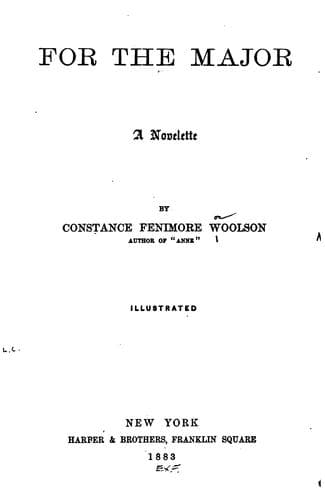
For the Major: A NoveletteWoolson, Constance Fenimore
General
For the Major: A Novelette
Woolson, Constance Fenimore
Psychological fiction; United States -- Social life and customs -- 19th century -- Fiction
Scar and the Major were sitting at the open window of the library as the
two ladies alighted at the door. "Mamma, it seems a _very_ long time
since you and sister Sara went away," said the child, leaning out to
speak to them. "Papa and I have taken a walk, and looked at all our
pictures, and told all our stories; and now we are sitting here waiting
for you."
"I will come in a few minutes, my pet," said Madam Carroll.
Sara went directly to the library, and sat down beside her father's
chair. He wished to hear all about the funeral of "that poor young man,"
and she answered his questions at length, and told him everything she
could think of in connection with it. The Major had known Dupont but
vaguely; he had seen him at the reception, but the face had faded from
his memory, and he should not have known him had they met again. He was
a musical genius who had appeared among them. He was glad that he had
appeared; it was a variety, and they had so little variety in Far
Edgerley. Good music was always an addition, and Marion was very fond
of music, very; he was glad she could have this little enjoyment. He had
said this to Marion several times. But it was a sad end--very--to die
alone among strangers, so far from home.
After some delay, Madam Carroll came in. She had taken off her black
dress and put on a bright little gown of blue; her hair had been
recurled, and there was a lovely color in her cheeks, and some sprays of
cream-colored honeysuckle in her blue belt. As she came nearer, the
Major's old eyes dwelt upon her with childlike pleasure and pride. "You
are looking very charming this evening, Madam Carroll," he said, with
his old-fashioned gallantry.
She sat down beside him. "Sara has been telling me about the funeral of
that unfortunate young musician," he continued. "It was like you,
Marion, to show so much kindness to the poor fellow, whoever he was, and
I am glad you did it. Kindness to the unfortunate and the stranger has
always been an especial characteristic of the Carroll family, and you
have merely represented me in this matter, done what I, of course,
should have done had I been well--had I quite recovered from my illness
of last winter, you know. But I am much improved--much improved. This
poor young man seems to have been utterly alone in the world, since even
when he was dying, and knew that he was, he told no one, as I
understand it, anything of his parentage, or life, or history, and left
no letters or even a message for friends. It is really quite
remarkable."
"Papa," said Sara, "now that we are all here, wouldn't it be a good time
to look at the new photographs?" The photographs were views of English
scenery which she had sent for; the Major had been in England, and liked
to relate reminiscences of his visit. He was interested at once.
"Certainly," he answered, with alacrity, "an excellent idea. Scar, get
the boxes."
Public-domain text, read in full here on John Shaqi.
Reviews
Reviews
No reviews yet
Be the first to share your thoughts on this work.
Elsewhere in the archive
Join the Discussion
Join the discussion
Sign in to leave a comment or review.
Sign InorCreate an account