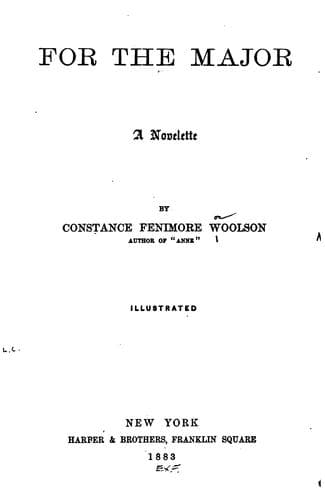
For the Major: A NoveletteWoolson, Constance Fenimore
General
For the Major: A Novelette
Woolson, Constance Fenimore
Psychological fiction; United States -- Social life and customs -- 19th century -- Fiction
"We must bear with each other, Sara," she said, as she lay with her eyes
closed. "For amid all our other feelings, there is one which we have in
common, our love for your father. That is and always must be a tie
between you and me."
"Always," answered Sara.
A little after daylight the Major woke. There had been no return of the
fever; he had slept in peace while they kept the vigil near him; his
illness was over. As he opened his eyes, his wife came to the bedside;
she had just risen--or so it seemed, for she wore a rose-colored
wrapper, and on her head a little lace cap adorned with rose-colored
ribbon. The Major had not seen the cap before; he thought it very
pretty.
"Trying to be old, are you, Madam Carroll?" he said; "old and matronly?"
Sara came in not long afterwards; she, too, was freshly dressed in a
white wrapper.
"I have brought you your breakfast, papa," she said.
"Isn't it earlier than usual?" asked the Major, turning his dim eyes
towards the window. But he could not see the light of the sunrise on the
peaks.
"I am afraid, Major, that you are growing indolent," said Madam Carroll,
with pretended severity, as she poured out his tea.
"Indolent?" said the Major--"indolent? Indolence is nothing to vanity.
And you and Sara, in your pink and white gowns, are living images of
vanity this morning, Madam Carroll."
[Illustration: "I AM AFRAID, MAJOR, THAT YOU ARE GROWING INDOLENT."]
CHAPTER VIII.
Autumn at last came over the mountains; she decked them in her most
sumptuous colors, and passed slowly on towards the south. The winds
followed the goddess, eight of them; they came sounding their long
trumpets through the defiles; they held carnival in the high green
valleys; they attacked the forests and routed the lighter foliage, but
could not do much against the stiff, dark ranks of the firs. They
careered over all the peaks; sometimes they joined hands on
Chillawassee's head, and whirled round in a great circle, laughing
loudly, for half a day; and then the little people who lived on the
ground said to each other that it "blew from all round the sky."
They came to Far Edgerley more than once; they blew through Edgerley
Street; at night the villagers in their beds heard the long trumpets
through the near gorges, and felt their houses shake. But they were
accustomed to these autumn visitors; they had a theory, too, that this
great sweeping of their peaks and sky was excellent for their mountain
air. And upon the subject of their air there was much conceit in Far
Edgerley.
Public-domain text, read in full here on John Shaqi.
Reviews
Reviews
No reviews yet
Be the first to share your thoughts on this work.
Elsewhere in the archive
Join the Discussion
Join the discussion
Sign in to leave a comment or review.
Sign InorCreate an account