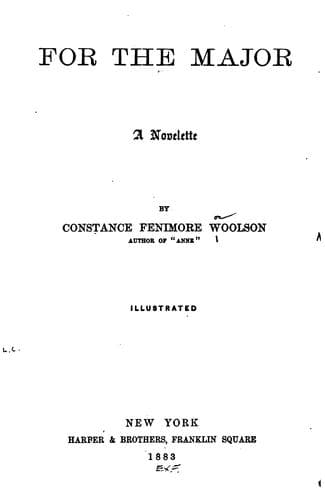
For the Major: A NoveletteWoolson, Constance Fenimore
General
For the Major: A Novelette
Woolson, Constance Fenimore
Psychological fiction; United States -- Social life and customs -- 19th century -- Fiction
When at length the winds had betaken themselves to the lowlands, with
the intention of blowing across the levels of Georgia and Florida, and
coming round to surprise the northerners at Indian River and St.
Augustine, the quiet winter opened in the mountains they had left behind
them. The Major had had no return of his October illness; he came to
church on Sundays as usual, and appeared at his wife's receptions. It
was noticed, although no one spoke of it, that he did not hold himself
quite so erect as formerly, and that perhaps his eyesight was not quite
so good; but he still remained to his village the exemplar of all that
was noble and distinguished, and they admired him and talked about him
as much as ever. He was their legend, their escutcheon; so long as they
had him they felt distinguished themselves.
The winter amusements began about Christmastime. They consisted
principally of the Sewing Society and the Musical Afternoons. To these
entertainments "the gentlemen" came in the evening--F. Kenneway, Mr.
Phipps, the junior warden, and the rector, when they could get him. A
Whist Club had, indeed, been proposed. There was a double motive in
this proposal. There were persons in the congregation who considered
whist-playing a test of the best churchmanship; these were secretly
desirous to see the test applied to the new rector, or rather the new
rector applied to it. But the thoughtful Mrs. Greer, having foreseen
this very possibility at an early date in the summer, had herself
sounded the rector upon the subject, and brought back a negative upon
the end of her delicate conversational line. She had asked him if he
thought that the sociability engendered by card-tables at small parties
could, in his opinion, counterbalance the danger which familiarity with
the pasteboard squares might bring to their young men (Phipps and
Kenneway); and whether he himself, at moments of leisure, and when he
wished to rest from intellectual fatigue, of which, of course, he must
have _so_ much, ever whiled away the time with these same gilded
symbols, not with others, but by himself.
Owen, who had not for the moment paid that attention to the eloquence of
Mrs. Greer which he should have done, did not understand her. He had
received an impression of cymbals. This was no surprise to him; he had
found Mrs. Greer capable of the widest range of subjects.
"I mean the painted emblems, you know--cards," explained Mrs. Greer;
"clubs, diamonds, and spades, Mr. Owen. Nor should we leave out hearts.
I was referring, when I spoke, to solitaire. But there is also whist.
Whist is, in its way, a climate by itself--a climate of geniality."
Public-domain text, read in full here on John Shaqi.
Reviews
Reviews
No reviews yet
Be the first to share your thoughts on this work.
Elsewhere in the archive
Join the Discussion
Join the discussion
Sign in to leave a comment or review.
Sign InorCreate an account