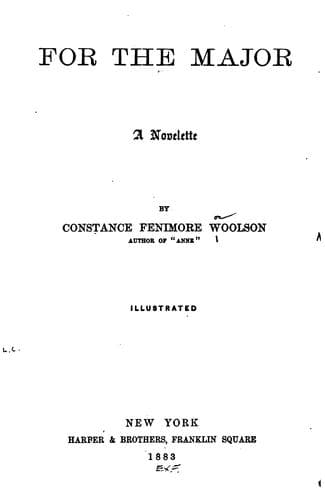
For the Major: A NoveletteWoolson, Constance Fenimore
General
For the Major: A Novelette
Woolson, Constance Fenimore
Psychological fiction; United States -- Social life and customs -- 19th century -- Fiction
This was a phrase of Madam Carroll's. Mrs. Greer had collected a large
assortment of phrases from the overflow of the Farms. These she
treasured, and dealt out one by one; her conversation was richly adorned
with them. She had excellent opportunities for collecting, as Madam
Carroll had long been in the habit of telling her any little item which
she wished to have put in circulation through the village in a certain
guise. She always knew that her exact phrase would be repeated, but not
as hers; it would be repeated as if it were original with the lady who
spoke it. This was precisely what Madam Carroll intended. To have said
herself, for instance, that the new chintz curtains of her drawing-room
combined delicacy and durability, and a bower-like brightness, was too
apparent; but for Mrs. Greer to say it (in every house on Edgerley
Street) was perfectly proper, and accomplished the same result. The
whole town remarked upon the delicacy and the durability and the
bower-like brightness; and the curtains, which she had made and put up
herself at small expense, took their place among the many other
peculiarly admirable things possessed by the Farms. Upon the present
occasion, however, Mrs. Greer gave Madam Carroll's name to the phrase
she had repeated; she thought it would have more influence. "Yes, that
is what our dear Madam Carroll used to call it--a climate of geniality,"
she said, looking at the rector with an inquiring smile.
But, ignoring the phrase of the Farms, none the less did Owen bring out
his negative; with the gilded symbols he did not amuse himself, either
alone or in company.
Armed, therefore, with this knowledge, Mrs. Greer was ready; she met the
project of the Whist Club in its bud, and vanquished it with a Literary
Society, whose first four meetings she gave herself, with a delicate
little hot supper thrown in. The Whist Club could not stand against
this, Miss Honoria Ashley, who was its chief supporter, offering only
apples and conversation. But a large cold apple on a winter night is not
calculated to rouse enthusiasm; while, as to conversation, everybody
knew that hot coffee promoted it. So the Literary Society conquered, and
the whist test was not, for that season at least, applied to the
churchmanship of the rector.
During these winter months Owen kept himself constantly busy. It was
thought that he worked too hard. He looked tired; sometimes, young and
strong as he was, he looked worn. There was a good deal of motherly
anxiety about this; some sisterly, too. Ferdinand Kenneway said that he
felt towards him like a brother. But Owen pursued his own course,
unmindful of these sympathetic feelings. He came to Madam Carroll's
receptions as usual, but did not stay long: he was the last to come and
the first to go. He called at the Farms, though not often; and when he
went there, he did not go alone.
Public-domain text, read in full here on John Shaqi.
Reviews
Reviews
No reviews yet
Be the first to share your thoughts on this work.
Elsewhere in the archive
Join the Discussion
Join the discussion
Sign in to leave a comment or review.
Sign InorCreate an account