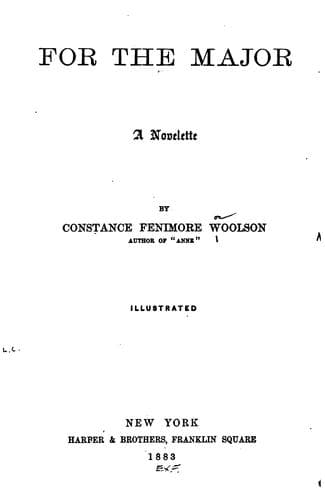
For the Major: A NoveletteWoolson, Constance Fenimore
General
For the Major: A Novelette
Woolson, Constance Fenimore
Psychological fiction; United States -- Social life and customs -- 19th century -- Fiction
The junior warden kept his room all day; he could not bear to hear it
talked about. Then the next morning out he went at an early hour to see
everybody he knew, and he told them all how very imprudent Carroll had
always been, recklessly so, recklessly. He was up and down Edgerley
Street all day, swinging his cane more than usual as he walked, thus
giving a light and juvenile air to his arms and shoulders, which was
perhaps somewhat contradicted by the uncertain tread of his little old
feet. In the afternoon Frederick Owen went to the Farms; for the first
time since the preceding October he went alone. Miss Carroll was in the
drawing-room when he came in; she was receiving a visit of general
inquiry and condolence from the three Miss Rendleshams. They went away
after a while, and then, before he had had time to speak--as he stood
there realizing that he had not been alone with her since that day, now
six months in the past, when she had told him of her engagement to
Dupont--he saw through the open door of the drawing-room the small
figure of Madam Carroll. She had not come down to see the three Miss
Rendleshams. But she did come down to see the rector. She came straight
to him, with her quick, light step. "I heard that you were here, and
came down. I am anxious to see you, Mr. Owen. Not to-day, but soon. I
thought I would come down myself and ask you; I did not want to write a
note."
"At any time you will name," answered Owen. He had risen as she entered.
Miss Carroll had seemed to him unchanged, save that her eyes showed that
she had been crying; but the Major's wife, he said to himself, with
almost awe-struck astonishment--the Major's wife, had he met her
elsewhere, he should hardly have known. Her veil of golden hair, no
longer curled, was put plainly back, and fastened in a close knot
behind; her eyes, the blue eyes he had always thought so pretty, looked
tired and sunken and dim, with crows'-feet at their corners; all her
lovely bloom was gone, and the whole of her little faded face was a
net-work of minute wrinkles. She was still small and slender, and she
still had her pretty features; but this was an old woman who was talking
to him, and Madam Carroll had been so young.
"It will not be for some days yet, I think," she was saying. "I shall
wait until the doctor has made up his mind. He wants more time, though I
want none; when he does make it up, it will be as mine is now. But I
prefer to wait until he sees clearly; will you ask him from day to day
what he thinks, and, when he has decided, then will you come?"
"Yes," replied Owen. "But do you mean that the Major--"
"I mean that the Major is in no immediate danger; that he will continue
about the same. He will not grow better, but neither will he grow much
worse. He may be brighter at times, but he will not regain his memory;
that is gone. But we shall not lose him, Mr. Owen, that is our great
happiness. We shall not lose him, Sara and I, as we had at first
feared."
Public-domain text, read in full here on John Shaqi.
Reviews
Reviews
No reviews yet
Be the first to share your thoughts on this work.
Elsewhere in the archive
Join the Discussion
Join the discussion
Sign in to leave a comment or review.
Sign InorCreate an account