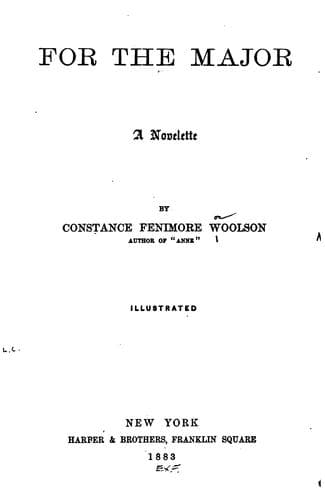
For the Major: A NoveletteWoolson, Constance Fenimore
General
For the Major: A Novelette
Woolson, Constance Fenimore
Psychological fiction; United States -- Social life and customs -- 19th century -- Fiction
Two tears rolled down her cheeks as she spoke. "It is because I am so
thankful," she said, wiping them away. Her long lace-bordered sleeves
had been turned back, and Owen was struck with the old, withered look of
her small wrists and hands.
"I could not have borne it to lose him now," she went on, as if
explaining. "You may think that existence such as his will be is no
blessing, nothing to be desired for him or for me. But he is not
suffering, he is even happy as a child is happy, and he knows me. He
would be content himself to wait a little, if he could know how much it
was to me, how much to have him with me, so that I can devote myself to
him, devote myself entirely."
"You have always done that, Madam Carroll," said Owen, touched by her
emotion.
"You will come, then--on whatever day the doctor makes up his mind," she
said, controlling herself, and returning to her subject.
Here Miss Carroll spoke. "Isn't it better not to make engagements for
the present, mamma?" she said, warningly. "You will overtax your
strength."
"It is overtaxed at this moment far less than it has been for many a
long month," answered Madam Carroll, as it seemed to Owen, strangely.
She passed her hand over her forehead, and then, as if putting herself
aside in order to consider her companions for a moment, she looked first
at Sara, then turned and looked at Owen. "Do not stay any longer now,"
she said to him, gently, in an advising tone. He obeyed her, and went
away.
On the tenth day after this the doctor, whose conclusions, if slowly
made, were sure, announced his decision: it tallied exactly with that of
Madam Carroll. The Major was in no present danger; his physical health
was fairly good; his condition would not change much, and he might
linger on in this state for several years. And then the Far Edgerley
people, knowing that no more pain would come to him, and that he was
tranquil and even happy, that he recognized his wife, and that she gave
to him the most beautiful and tender devotion--then these Far Edgerley
people were glad and thankful to have him with them still; not wholly
gone, though lying unseen in his peaceful room, which faced the west, so
that the sunset could shine every day upon the quiet sunset of his life.
And they thought, some of them, that thanksgiving prayers should be
offered for this in the church. And they all prayed for him at home,
each family in its own way.
Public-domain text, read in full here on John Shaqi.
Reviews
Reviews
No reviews yet
Be the first to share your thoughts on this work.
Elsewhere in the archive
Join the Discussion
Join the discussion
Sign in to leave a comment or review.
Sign InorCreate an account