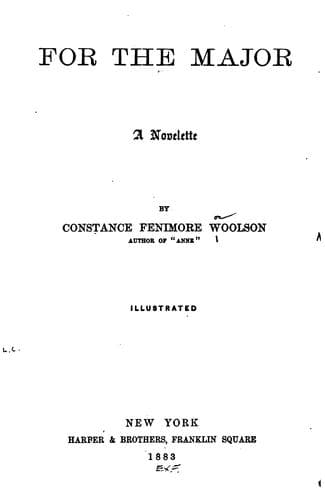
For the Major: A NoveletteWoolson, Constance Fenimore
General
For the Major: A Novelette
Woolson, Constance Fenimore
Psychological fiction; United States -- Social life and customs -- 19th century -- Fiction
Left alone, Sara Carroll looked round her room. As much had been done to
make it bright as woman's hands, with but a small purse to draw upon,
could accomplish. The toilet-table, the curtains, the low lounge, with
its great, cool, chintz-covered pillows, the hanging shelves, the
easy-chair, the writing-table--all these were miracles of prettiness and
ingenuity. But the person for whom this had been done saw it but
vaguely. She was thinking of only one thing--her father; that he had not
waited to welcome her; that she should not see him until half-past ten
the next morning. What could this mean? If he were ill, should not his
daughter be the first to see him, the first to take care of him? She
had told Madam Carroll that she would not begin the new home life by
being jealous of her. But there was something very like jealousy in the
disappointment which filled her heart as she laid her head upon the
pillow. She had looked forward to her home-coming so long; and now that
she held it in her grasp it was not at all what she had been sure it
would be.
Upon this same Saturday evening, at dusk, light was shining from the
porch and windows of St. John in the Wilderness, the Episcopal church of
Far Edgerley. This light shone brightest from the porch, for there was a
choir rehearsal within, and the four illuminating candles were down by
the door, where stood the organ. Two of the candles illumined the
organist, Miss Rendlesham the second, that is, Miss Millie; the others
lighted the high music-stand, behind which stood the choir in two rows,
the first very crowded, the second looking with some difficulty over the
shoulders of the first at the lighted books which served for both,
little Miss Tappen, indeed, who was short, being obliged to stand on
four unused chant-books, piled. In the front row were the soprani, eight
in number, namely, Miss Rendlesham the elder, and her sister; the three
Misses Greer; Miss Dalley and her two cousins, the Farrens, who were
(which was so interesting) twins. In the back row were the two
contralti, Miss Bolt and the already-mentioned Miss Tappen on her books,
together with the tenor, Mr. Phipps; there, too, was the basso, Mr.
Ferdinand Kenneway, a bachelor of amiable aspect, but the possessor
also, in spite of amiability, of several singularly elusive qualities
which had tried the patience of not a few.
The music-stand, no doubt, was very much too short for this company. But
then it was intended for a quartette only, and had served without
question for four estimable persons during the long, peaceful rectorship
of good old Parson Montgomery, who had but recently passed away. Since
the advent of his successor, the Reverend Frederick Owen, three months
before, the choir had trebled its size without trebling that of the
stand; the result was naturally that which has been described.
The Reverend Frederick Owen was an unmarried man.
Public-domain text, read in full here on John Shaqi.
Reviews
Reviews
No reviews yet
Be the first to share your thoughts on this work.
Join the Discussion
Join the discussion
Sign in to leave a comment or review.
Sign InorCreate an account