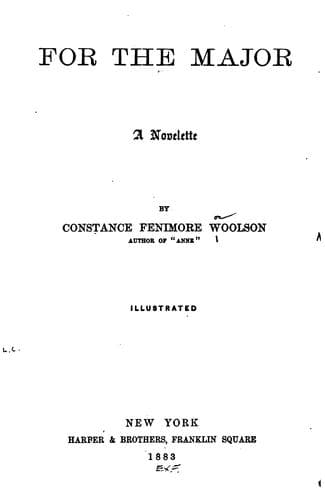
For the Major: A NoveletteWoolson, Constance Fenimore
General
For the Major: A Novelette
Woolson, Constance Fenimore
Psychological fiction; United States -- Social life and customs -- 19th century -- Fiction
Before the 12th of October my son was taken
ill, as I had feared. And the rest--you know. The time when I could tell
you this has now come. It has come because nothing can again disturb the
Major's peace. He is near us in touch, and close to our love, but
earth's sorrows and pains can trouble him no more. I can therefore tell
you, and I do it for two reasons. One is that it will explain to you the
course we took; it will explain to you what Sara said that afternoon,
for I think that it has grieved you--what Sara said. It was an expedient
that she thought of to divert your attention, to stop further action on
your part. We knew--from your having tried to see the Major, and see
him alone--that you had learned something; how much, we could not tell.
And when you came again the next day, and spoke as you did, first to me,
and then to her, and I was frightened and lost my courage, fearing lest
you should speak to others also; then Sara took the only expedient she
could think of to silence you, to stop you effectually, and thus secure
her father's peace. But it was only an expedient, Mr. Owen. It was never
true." She paused for the first time in the utterance of her brief
sentences, turned her head, and looked at him with her faded, tired
eyes.
Owen's own eyes were wet. "Even before that," he said, "and I do not
deny how important it is to me--more important than anything else in the
world--even before that, Madam Carroll, I beg you to say that you
forgive me, that you forgive what I did and said. I did not know--how
could I?--and I was greatly troubled."
"I think I can say that I have forgiven you," answered Madam Carroll. "I
did not at first; I did not for a long time. It is all over now; and of
course you did not know. But you never understood my son--you could not;
and therefore--if you will be so good--I should prefer that you should
not speak to me of him again; it is much the easiest way for us both."
She turned her eyes back to the wall. "About Sara," she continued,
without pause, "it was a pity. It has been a long time for you to
wait--with that--that mistaken belief on your mind. But, while the Major
was still with us in his consciousness and his memory, I could not tell
to you, a stranger, what I was not able to tell him."
"You were afraid to trust me!" said Owen, a pained expression coming
into his face.
"Yes," answered Madam Carroll, simply.
"You did not know then that I felt as far as possible from being a
stranger? That I wished--that I have tried--"
"That is later; I was coming to that. Yes--since I have known that you
cared so much for her (though I knew it long ago!)--since you have
spoken, rather, I have felt that I wished to tell you, that I would
gladly tell you, as soon as I could. The time has come, and it came
earlier than I expected, though I knew it could not be long delayed. I
have taken the earliest hour."
"Then she--then Miss Carroll told you that I--that I had spoken?" said
Owen.
Public-domain text, read in full here on John Shaqi.
Reviews
Reviews
No reviews yet
Be the first to share your thoughts on this work.
Elsewhere in the archive
Join the Discussion
Join the discussion
Sign in to leave a comment or review.
Sign InorCreate an account