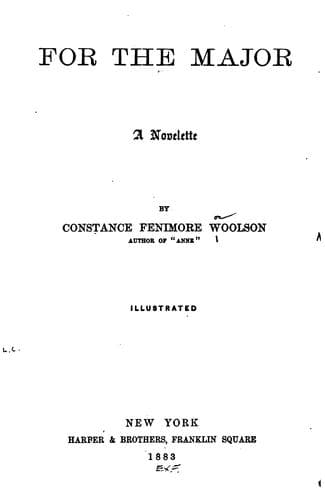
For the Major: A NoveletteWoolson, Constance Fenimore
General
For the Major: A Novelette
Woolson, Constance Fenimore
Psychological fiction; United States -- Social life and customs -- 19th century -- Fiction
Then it was that he put his hand on my arm, and said: 'Don't you know
me, mother? I am Julian, the little boy you thought dead.' He was
thirty-one years old, and I had lost him before he was eight. What had
startled me was his likeness to his father. They had escaped, after all.
His father had feigned death; he had let himself be swept along, keeping
hold of the child, who was unconscious. It was a desperate expedient.
But he was desperate. He was an expert swimmer, and he succeeded, though
barely, with life just fluttering within them. They lay hid in a
canebrake for some days, and then, after much difficulty, they made
their way out of the country. They went to Mexico. Then they went to the
West India Islands. They lived in Martinique, and they took the name of
Dupont. My husband did not try to come back; a reward had been offered
for him before he fled; there was a price on his head. He knew that I
supposed him dead, and he was quite willing to be dead--to me. He was
tired of me. I was only a burden to him. I was always talking about
little things. My son thought that we were dead--his little sister and
I; his father had told him so. But after his father's death he found
among his papers some memoranda which made him think that perhaps we
were not, that perhaps he could even find us. He did not try
immediately; it was but a chance, and he was interested in other things.
But later he did try; that is, in his way; he was never sharp and
energetic--as you are. He found me; but his little sister had gone to
heaven. My son had had only the education of the islands, and he was,
besides, a musician. The temperament of musicians is peculiar. You will
allow me to say that I think you do not understand it. He wished to go
back to the islands; he had been in the United States for a year, and he
did not like the life or climate. I helped him as much as I could. It
was not much; but he started. Then he had that illness in New York, and
came back. It was most important that he should start again, and
soon--before the return of winter. I had nothing to give him, and so I
went to my daughter--I mean my step-daughter, Sara. She has, you know, a
small income of her own, left her by her uncle. You are asking yourself
why I did not go to the Major; why there should have been any secret
about it from the first. It was because I had not told him at the time
of our marriage, or at any time, that I had ever had a son. He thought
when he married me that Cecilia was my only child; he thought me
twenty-three, when I was in reality over thirty-five. It would have been
a great shock and pain to him to know that I had deceived him--a shock
which, in his state of health at that time, he could not have borne.
When Sara knew, she helped me; she helped me nobly. But the time for the
semi-annual payment of her income was not until the 12th of October, and
by the terms of her uncle's will she could not anticipate it; we were
therefore obliged to wait.
Public-domain text, read in full here on John Shaqi.
Reviews
Reviews
No reviews yet
Be the first to share your thoughts on this work.
Elsewhere in the archive
Join the Discussion
Join the discussion
Sign in to leave a comment or review.
Sign InorCreate an account