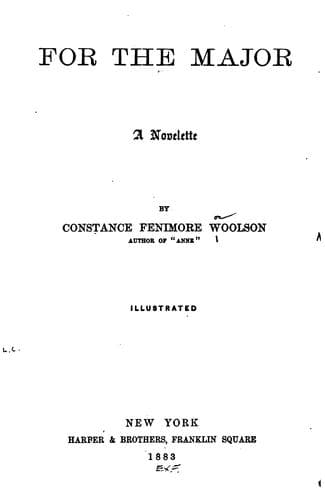
For the Major: A NoveletteWoolson, Constance Fenimore
General
For the Major: A Novelette
Woolson, Constance Fenimore
Psychological fiction; United States -- Social life and customs -- 19th century -- Fiction
"Ah, you do _not_ like me, though you try to help me," cried the young
man. "But give me time, Madam Carroll; give me time."
"To make me like you? Take as much as you please. But do not take it
with Sara."
"I shall take five minutes," Owen answered. Then he lifted her hand to
his lips. "Forgive me for thinking of my own happiness," he said, with
the gentlest respect.
"I like you to think of it; it gives me pleasure. And now I must come to
my second reason for telling you. You remember I said that there were
two. This is something which even Sara does not know--I would not give
her any of that burden; she could not help me, and she had enough to
bear. She could not help me; but now you can. It is something I want you
to do for me. It could not be done before, it could not be done until
the Major became as he is at present. No one now living knows; still, as
you are to be one of us, I should like to have you do it for me."
And then she told him.
CHAPTER IX.
On Easter Sunday morning Far Edgerley people woke to find their village
robed in blossoms; in one night the fruit trees had burst into bloom, so
that all the knolls and Edgerley Street itself stood in bridal array,
and walking to church was like taking part in a beautiful procession.
Nearly a month had passed since the Major's attack; but all his old
friends in the congregation of St. John's missed him more than ever on
this Easter morning. Sara and Scar were in the Carroll pew at the head
of the aisle; but it looked very empty, nevertheless. During this month
there had not been much change in the Major, save that for two weeks
after the doctor's decision he had not been so well; restlessness had
troubled him. But for the preceding few days he had been much better,
and every one was cheered by this; every one was interested in hearing
that he had talked quite at length with his wife on simple local
subjects, that he enjoyed little things, and thought about them. He
lived entirely in the present, the present of the passing moment;
everything in the past he had forgotten, and he speedily forgot the
moment itself as soon as it was gone. What his wife said to him he
understood, and he always knew when she was near, though his blind eyes
could not see her; he felt for a fold of her dress or the ruffle of her
sleeve, and held it; the sense of touch had taken the place of the
vanished sight. He listened for Scar's voice too, and seemed to like to
have him in the room, to hold the child's hand in his. In the same way
he always smiled and was pleased when Sara spoke to him.
Public-domain text, read in full here on John Shaqi.
Reviews
Reviews
No reviews yet
Be the first to share your thoughts on this work.
Elsewhere in the archive
Join the Discussion
Join the discussion
Sign in to leave a comment or review.
Sign InorCreate an account