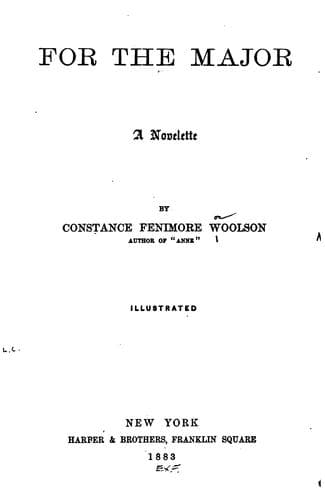
For the Major: A NoveletteWoolson, Constance Fenimore
General
For the Major: A Novelette
Woolson, Constance Fenimore
Psychological fiction; United States -- Social life and customs -- 19th century -- Fiction
When the morning service was over, every one waited to ask how the Major
was on this lovely Easter Sunday. Lately they had come to like his
daughter far better than they had liked her at first; they said she
talked more, that she was not so cold. Certainly there was nothing cold
in her face, but a beautiful sweetness, as she rose from her knees and,
taking Scar's hand, turned to go down the aisle. She answered their
questions on the steps and in the church-yard. For on Easter morning Far
Edgerley people always brought many flowers to church; then, after
service, they took them out and laid them upon all the graves, so that,
as Scar once said, "they could have their Easter Sunday too." Every
mound had its blossoms to-day, and there were many upon the grave of
the young stranger, Louis Dupont; this was because there was no one,
they said, to remember him. So they all remembered him.
A little before sunset Frederick Owen, having officiated at the Easter
service of the Sunday-school and at one of his mission stations, was on
his way to Carroll Farms. As he came up Carroll Lane and crossed the
little bridge over the brook, he saw that there was more bloom here than
anywhere else in all the blooming town. For the whole orchard was out
behind the house, and all the flowering almonds in front of it; the old
stone walls rose close pressed in blossoms. Sara opened the door before
he had time to knock. "I was watching for you," she said. "Judith Inches
and Caleb have gone up the mountain to see their mother, as they always
do on Easter afternoon, and they have taken Scar."
Owen paused in the hall to greet her; he was very proud of this proud,
reserved girl whose love he had won.
"Do not wait, Frederick. Mamma has such a pleadingly sorrowful look
to-day that I want to have it over."
"Only a moment," said Owen. He was standing with his arm round her,
holding her close. "Do you remember that afternoon when I spoke to you
of your mother, of the sisterly kindness she had shown to that poor
woman who had lost her crippled boy? And do you remember that you said
that no one save those who were in the house with her all the time could
comprehend the one hundredth part of her tenderness, her constant
thought for others? Your answer put me in a glow of pleasure, I did not
then comprehend why. I asked myself as I walked home if I cared so much
to hear Madam Carroll praised. I know now what I cared for--it was
because _you_ had said it. For I had been afraid, unconsciously to
myself, perhaps, that you did not fully appreciate her, appreciate her
as she seemed to me."
"And I had not until then. I shall always reproach myself--"
"You need not; you have made up for it a hundredfold," answered Owen.
Then, coming back to himself, with love's unfailing egotism--"I wonder
if you realize all the suffering I went through?" he continued. "You
made me wait in my pain so long, so long!"
Public-domain text, read in full here on John Shaqi.
Reviews
Reviews
No reviews yet
Be the first to share your thoughts on this work.
Elsewhere in the archive
Join the Discussion
Join the discussion
Sign in to leave a comment or review.
Sign InorCreate an account