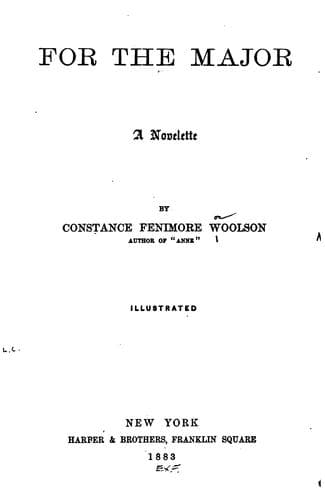
For the Major: A NoveletteWoolson, Constance Fenimore
General
For the Major: A Novelette
Woolson, Constance Fenimore
Psychological fiction; United States -- Social life and customs -- 19th century -- Fiction
"We suffer more than you do, always," answered, after a moment, the
woman he held in his arms. And then into her beautiful eyes, raised to
meet his, there came such a world of feeling, some of it beyond his ken,
that touched, stirred, feeling himself unworthy, yet exultant in his
happiness, the man who loved her rested his lips on hers without
attempting further reply.
A moment later he went up the stairs, and Sara turned the key of the
front door. The Major, his wife and daughter, and the clergyman were now
alone in the flower-encircled house. All its windows were open, and the
flowers fairly seemed to be coming in, so near were they to the
casements; outside the Major's windows two great apple-trees, a mass of
bloom, stretched out their long, flowering arms until they touched the
sills.
The sun, now low down, was sinking towards Lonely mountain; he sent
horizontal rays full into the mass of apple-blossoms, but could not
penetrate them save as a faintly pink radiance, which fell upon the
figure of Madam Carroll as she stood beside the bed. She wore one of her
white dresses, but her face looked worn and old as the radiance brought
out all its lines, and showed the many silver threads in her faded hair.
The Major was sitting up in bed; he had on a new dressing-gown, and was
propped with cushions.
"Has the clergyman come?" he said. He spoke indistinctly, but his wife
could always understand him.
"Yes, he is here, Scarborough," she answered, bending over him.
"He is welcome. Let him be seated," said the Major, in his old
ceremonial manner. Then he felt for his wife's arm, and pulled her
sleeve. "Am I dressed?" he asked, anxiously. "Did you see to it? Is my
hair smooth?" He supposed himself to be speaking in a whisper.
"Yes, Major, you have on your new dressing-gown, and it is of a
beautiful color, and your hair is quite smooth."
"I don't feel sure about the hair," said the Major, still, as he
supposed, confidentially. "I don't remember that I brushed it."
Madam Carroll took a brush from the table and gently smoothed the thin
white locks.
"That is better," he murmured. "And my clean white silk handkerchief?"
"It is by your side, close to your hand."
He thought for a moment. "I ought to have a flower for my button-hole,
oughtn't I?" he added, looking about the room with his darkened eyes as
if to find one.
Sara went to the window and broke off a spray of apple-blossoms from the
tree outside. His wife gave it to him, and he tried to put it into the
button-hole of his dressing-gown; she did it for him, and then he was
content. "I am ready now," he said, folding his hands.
Frederick Owen came forward; he wore his white robes of office. "Dearly
beloved, we are gathered together here in the sight of God to join
together this man and this woman in holy matrimony," he read, standing
close to the Major, so that he could hear.
The Major listened with serenity; and of his own accord, when the time
came, he answered, "I will."
Public-domain text, read in full here on John Shaqi.
Reviews
Reviews
No reviews yet
Be the first to share your thoughts on this work.
Elsewhere in the archive
Join the Discussion
Join the discussion
Sign in to leave a comment or review.
Sign InorCreate an account