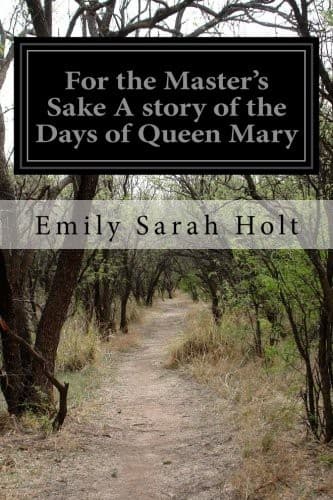
For the Master's Sake: A Story of the Days of Queen MaryHolt, Emily Sarah
History
For the Master's Sake: A Story of the Days of Queen Mary
Holt, Emily Sarah
Counter-Reformation -- England -- Fiction; England -- Social life and customs -- 16th century -- Fiction; Historical fiction
Will and Dickon, thus addressed, promptly knelt down, one on each side
of his mother, and Will proceeded to gabble over his prayers, followed
by Dickon with articulate sounds which had no other merit than that of
bearing some resemblance to the words in question.
The boys commenced by crossing themselves, then they raced through the
Paternoster, the Angelical Salutation, and the Creed, all in Latin; of
course without the faintest idea of any meaning. They then repeated a
short prayer in English, entreating the Virgin, their guardian angels,
and their patron saints, to protect them during the night. This done,
Will rattled off half a dozen lines (carefully emphasising the
insignificant words), which alone of all the proceeding had either
interest or meaning in his eyes.
"Matthew, Mark, Luke, and John,
Bless the bed that I lie on:
Four corners to my bed,
Four angels at their head--
One to read, and one to write,
And two to guard my bed at night."
"Good lads!" said Mistress Flint, as she rose and restored the crucifix
which she had been holding before the boys to its usual place.
"Mother!" said Will, who was inconveniently intelligent, "who be
Matthew, Mark, Luke, and John? Doth it mean Luke Dobbs, and Father?"
Mr Flint indulged himself in a quiet laugh.
"Nay, dear heart!" answered his mother. "Those be the holy Apostles,
that writ the Evangels."
"What be the Evangels, Mother?"
"Did ever one see such a lad to put questions?" demanded Mistress Flint.
"Why, child, they be writ in the great Bible, that lieth chained in the
Minster."
"What be they about, Mother?"
"Come, lad, if I tarry to answer all thy talk, thou shalt not be abed
this even," responded Mistress Flint discreetly; for this was a query
which she would have found it hard to answer; and with a playful show of
peremptoriness, she drove Will and Dickon upstairs to the bedchamber, in
which slept the five boys of the family.
There was a minute's silence, only broken by the movements of Helen and
Anne, who were putting away the bowls, jugs, and trenchers which had
been used at supper, when suddenly Mr Flint said--to nobody in
particular--
"What _be_ they about?"
His daughters looked up, and then resumed their occupation, with a shake
of the head from Anne, and a little laugh from Helen.
"Methinks, Master," said Agnes rather diffidently, "'tis about God, and
His love to men."
"What thereabout?" replied he, continuing to look into the fire.
"Why, Master," said Agnes, "surely you do wit better than I."
"Well, I wit nought thereabout, nor never want," said Anne a little
pettishly. "'Twill be time enough when I have the years o' my grandame,
I guess, to make me crabbed and gloomsome."
Agnes looked at her in amazement.
"Nan," said her father, "I heard thee this morrow a-singing of a
love-song."
"Well, so may you yet again," said she, laughing.
"That made thee not gloomsome, trow?" he asked.
"Never a whit! how should it?" replied Anne, still laughing.
Public-domain text, read in full here on John Shaqi.
Reviews
Reviews
No reviews yet
Be the first to share your thoughts on this work.
Join the Discussion
Join the discussion
Sign in to leave a comment or review.
Sign InorCreate an account