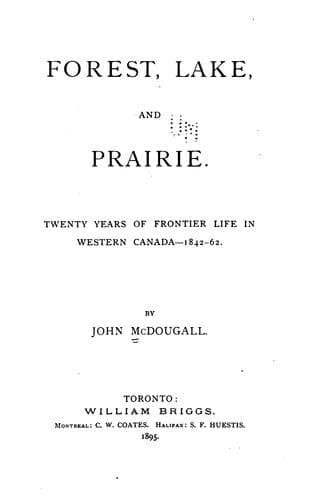
Forest, Lake and Prairie: Twenty Years of Frontier Life in Western Canada—1842-62McDougall, John
History
Forest, Lake and Prairie: Twenty Years of Frontier Life in Western Canada—1842-62
McDougall, John
Frontier and pioneer life -- Northwest, Canadian; McDougall, John, 1842-1917; Northwest, Canadian -- Description and travel
Of these we had two classes--those who belonged to the reserve at
Rama, and the pagans who roamed the "Muskoka country." Having the
language and intimate acquaintance with the life and habits of these
people, I was as "to the manner born," and thus had the advantage
over many others.
Many a wild ride I have had with those "Muskoka fellows." If we
heard of them coming, I would go to meet them with a big team and
sleigh, and bring them and their furs to town, and after they had
traded would take them for miles on their way.
While in town we would try and keep them from whiskey, but sometimes
after we got started out some sly fellow would produce his bottle,
and the drinking would begin, and with it the noise and bluster; and
I would be very glad when I got them out of my sleigh and had put
some distance between us.
Right across from us was another store, the owner of which had been a
"whiskey trader" the greater part of his life.
One morning I was taking the shutters off our windows, when a man
galloped up in great haste and told me he was after a doctor, that
there was someone either freezing or frozen out on the ice in the
bay, a little below the village; and away he flew on his errand.
The old "whiskey trader" happened just then to come to the door of
his store, and I told him what I had heard. With a laugh and an oath
he said, "John, I'll bet that is old Tom Bigwind, the old rascal."
(Poor Tom, an Indian, was the victim of drunkenness, and this man had
helped to make him so.) "He owes me, and I suppose he owes you also.
Well, I will tell you what we will do; you shall take his old squaw,
and I will take his traps."
My boyish blood was all ablaze at this, but as he was a white-headed
old man, I turned away in disgust.
I then went in to breakfast, and when I came out I had an errand down
the street, and presently met the old trader, all broken up and
crying like a child. I said, "What is the matter?" and he burst out,
"Oh, it is George! Poor George!" "What George?" I asked; and he
said, "My son! my son!" And then it flashed upon me--for I knew his
son, like old Tom, the Indian, had become a victim of the same curse.
Ah! thought I, this is retribution quick and sharp.
I went on down to the town hall, into which the lifeless body had
been brought, and there, sure enough, was _poor George's body,
chilled to death out on the ice while drunk!_
One of the gentlemen present said to me, "John, you must go and break
this sad event to his wife."
I pleaded for someone else to go, but it was no use. I was
acquainted with the family, had often received kind notice from this
poor woman who now in this terrible manner was widowed, and with a
troubled heart I went on my sad errand.
What had spoken to her? No human being had been near the house that
morning, and yet, with blanched face, as if in anticipation of woe,
she met me at the door.
Public-domain text, read in full here on John Shaqi.
Reviews
Reviews
No reviews yet
Be the first to share your thoughts on this work.
Join the Discussion
Join the discussion
Sign in to leave a comment or review.
Sign InorCreate an account