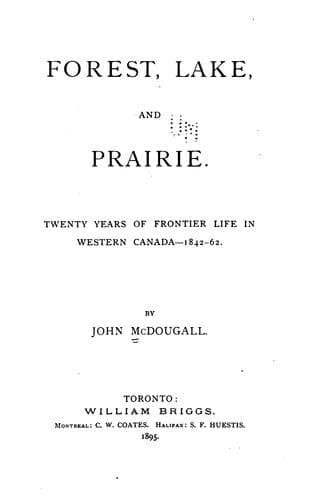
Forest, Lake and Prairie: Twenty Years of Frontier Life in Western Canada—1842-62 — John Shaqi
Forest, Lake and Prairie: Twenty Years of Frontier Life in Western Canada—1842-62McDougall, John
History
Forest, Lake and Prairie: Twenty Years of Frontier Life in Western Canada—1842-62
McDougall, John
Frontier and pioneer life -- Northwest, Canadian; McDougall, John, 1842-1917; Northwest, Canadian -- Description and travel
That night, before we went to sleep, I inquired of Mr. Murray if he
knew anything about pemmican, and with a laugh he replied, "Yes, my
boy, I was made acquainted with pemmican many years ago, and will be
pleased to introduce you to some in the morning." I would fain have
inquired about dogs, but my kind friend was already snoring. I could
not sleep so soon. This strange, wild, new country we had travelled
through for days, these Indian, and buffalo, and frontier stories I
had listened to at the stopping-places, and heard from the drivers as
we travelled--though born on the frontier yet all this was new to me.
Such illimitable plains, such rich soil, such rank grass--there was a
bigness about all this, and I could not help but speculate upon its
future.
With the early morn we were up, and using the Red River as our
wash-dish, were soon ready to investigate our new surroundings.
The first thing was pemmican. Mr. Murray took me to the storehouse,
and here, sure enough, was pemmican in quantity. Cords of black and
hairy bags were piled along the walls of the store. These bags were
hard, and solid, and heavy. One which had been cut into was lying on
the floor. Someone had taken an axe and chopped right through hair
and hide and pemmican, and here it was spread before me. My friend
stooped and took some and began to eat, and said to me, "Help
yourself," but though I had not eaten since supper yesterday, and we
had driven a long way after that, still the dirty floor, the hairy
bag, the mixture of the whole, almost turned my stomach, and I merely
said, "Thank you, sir." Ah! but soon I did relish pemmican, and for
years it became my staple food.
It was a wonderful provision of Providence for the aboriginal man and
the pioneer of every class.
For days we waited for the steamer; not a word reached us from
anywhere. In the meantime, father and I hunted and fished; we shot
duck and prairie chicken, and caught perch and pickerel and catfish
and mud-turtles, and explored the country for miles, though we were
cautioned about Indians, a war-party of whom one might strike
anywhere and any time.
The Red River was a sort of dividing line between the Ojibways and
the Sioux, the former to the east and the latter to the west of this
long liquid line of natural division.
By and by the steamer came, and, to our great disappointment, the
captain said he could not run her back down as the water was too low.
This captain was not of the kind of pioneer men who laugh at
impossibilities.
The next thing was to load a flat-bottomed barge and float her down.
We were allowed to erect our tent on a portion of the deck of the
scow, and soon we were moving down stream, having as motive power
human muscle applied to four long sweeps.
Day and night, with change of men, our scow kept on down this
slow-currented and tortuous stream. The only stop was to take on
wood for our cooking stove. Here I learned to like pemmican.
CHAPTER VII.
Public-domain text, read in full here on John Shaqi.
Reviews
Reviews
No reviews yet
Be the first to share your thoughts on this work.
Join the Discussion
Join the discussion
Sign in to leave a comment or review.
Sign InorCreate an account