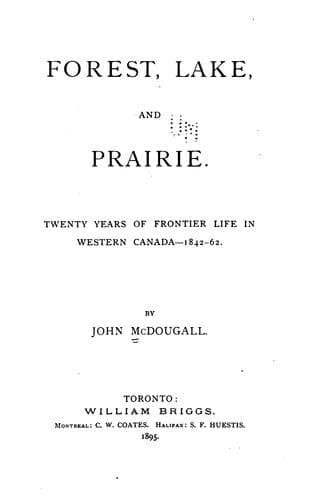
Forest, Lake and Prairie: Twenty Years of Frontier Life in Western Canada—1842-62McDougall, John
History
Forest, Lake and Prairie: Twenty Years of Frontier Life in Western Canada—1842-62
McDougall, John
Frontier and pioneer life -- Northwest, Canadian; McDougall, John, 1842-1917; Northwest, Canadian -- Description and travel
I will never forget my first goose. I broke his wing, and he came
down on the ice, and started to run out on the lake. I had a
single-barrelled muzzle-loading gun, and I loaded it before starting
after the big fellow. When he saw me coming he spurted, with legs
and wing. He made good time, and I ran and doubled, and after a long
chase came close enough to shoot him again, and stopped him.
The Hudson's Bay factor and clerks went a long distance and were away
some weeks on the goose hunt.
CHAPTER XI.
Opening of Navigation--Sturgeon fishing--Rafting timber--Sawing
lumber.
About the last of May the ice went off the lake, and navigation was
open. We made up another bee to go to raft our timber down. Father
sent William and I one day ahead of the party, in order that we might
set nets for sturgeon, which we did; and when father and men came up
next day, we had fourteen large sturgeon to begin with. While
white-fish is the staple food in that north country, these sturgeon
come in at seasons as an extra luxury; indeed, they are the beef and
bacon of the northern Indian. Sturgeon oil is both lard and butter
for these people, and blessed is the wife and mother who has many
vessels full of it.
We made a big raft of our timber, and both wind and current favoring
us, we soon had it hauled out and piled up on the beach near the
church. The sawing of the timber was gone into by the Indians in
turn, each doing his share. This we carefully piled, to season, and
in the autumn the Hudson's Bay Company, as per offer and promise,
sent their carpenters, and the enlargement went on. There was great
rejoicing and a grand reopening when the work was finished.
CHAPTER XII.
Summer transport--Voyageurs--Norway House--The meeting place of many
brigades--Missionary work intensified.
As the summer months are few in that northern climate, the need to
push transport matter is imperative.
Norway House was the first depot post in the interior, coming from
York Factory on the Hudson's Bay. Here were wintered the most of the
"green hands," those men who had been brought out by the ship the
previous summer, and from this point these men were distributed to
the various districts in the farther interior.
To Norway House, in the early summer, came the brigade of boats from
the Mackenzie River, the Athabasca, and English River, and Cumberland
districts.
Down from the west, the Saskatchewan and Swan River districts, came
the "Braroes" (I give the word as it was pronounced), the men from
the great plains. Down from the south, the Red River Brigade added
their quota to these fleets of inland transport.
Public-domain text, read in full here on John Shaqi.
Reviews
Reviews
No reviews yet
Be the first to share your thoughts on this work.
Join the Discussion
Join the discussion
Sign in to leave a comment or review.
Sign InorCreate an account