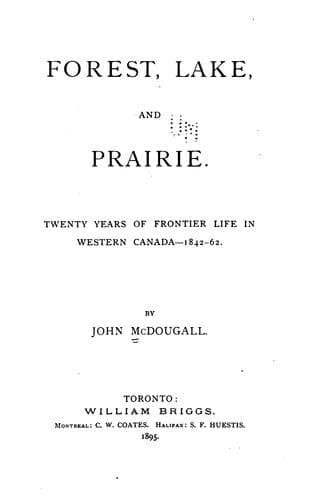
Forest, Lake and Prairie: Twenty Years of Frontier Life in Western Canada—1842-62McDougall, John
History
Forest, Lake and Prairie: Twenty Years of Frontier Life in Western Canada—1842-62
McDougall, John
Frontier and pioneer life -- Northwest, Canadian; McDougall, John, 1842-1917; Northwest, Canadian -- Description and travel
Overhauling the nets, taking care of the fish, mending and drying
your nets--all this keeps you busy almost all the time. In taking
whitefish out of the net, one uses teeth and hands. You catch the
fish in your hand, lift it to your mouth, and, taking hold of its
head with your teeth, you press down its length with both hands
meeting, and thus force the fish from the net without straining your
net. When the fish is loose from the net, you give a swing with your
head, and thus toss the fish into the boat behind you or away out on
the ice beside you.
All of this, except mending the nets in the tent, is desperately cold
work. The ice makes on your sleeves and clothing. Your hands would
freeze were it not that you keep them in the water as much as
possible.
In my time hundreds of thousands of whitefish were thus taken every
year for winter use, the principal food for men and dogs being fish.
When the lakes and rivers are frozen over, you take a long rope,
about a quarter of an inch in thickness, and pass it under the ice to
the length of your net. To do this you take a long dry pole, and
fasten your rope at one end of this; then you cut holes in the ice
the length of your pole apart in the direction you want to set your
net; you then pass this pole under the ice using a forked stick to
push it along, and in this way bring your line out at the far end of
where your net will be when set. One pulls the rope and the other
sets the net, carefully letting floats and stones go as these should
in order that the net hang right.
My man and I put up about two thousand white-fish, besides a number
of jack-fish. These were hauled home by dog-train.
My four pups which I bought from Mr. Sinclair over a year since were
now fine big dogs, but as wild as wolves. I had put up a square of
logs for a dog-house, and by feeding, and coaxing, and decoying with
old dogs, I finally succeeded in getting them into it. Then I would
catch one at a time, and hitch him with some old and trained dogs.
Father would go with me, and fight off the other three while I
secured the one I was breaking in, and by and by, I had the whole
four broken, and they turned out splendid fellows to pull and go.
Very few, if any, trains could leave me in the race, and when I
loaded them with two hundred hung fish, they would keep me on the
dead run to follow.
I was very proud of my first train of dogs, and also of my success in
breaking them.
Many a flying trip I gave father or mother and my sisters over to the
fort or out among the Indians. Sometimes I went with father to visit
Indian camps, and also to the Hudson's Bay shanties away up Jack
River, where their men were taking out timber and wood for the fort.
What cared we for the cold! Father was well wrapped in the cariole,
and I, having to run and keep the swinging cariole right side up, had
not time to get cold.
CHAPTER XV.
Winter trip to Oxford--Extreme cold--Quick travelling.
Public-domain text, read in full here on John Shaqi.
Reviews
Reviews
No reviews yet
Be the first to share your thoughts on this work.
Join the Discussion
Join the discussion
Sign in to leave a comment or review.
Sign InorCreate an account