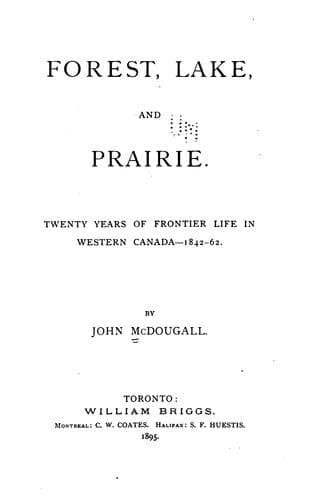
Forest, Lake and Prairie: Twenty Years of Frontier Life in Western Canada—1842-62McDougall, John
History
Forest, Lake and Prairie: Twenty Years of Frontier Life in Western Canada—1842-62
McDougall, John
Frontier and pioneer life -- Northwest, Canadian; McDougall, John, 1842-1917; Northwest, Canadian -- Description and travel
Mr. Woolsey also told me of a slight misunderstanding he had with a
priest. Mr. Woolsey did not understand French, and the priest did
not understand English. The cause of their trouble was about asking
a blessing and returning thanks at the Hudson's Bay Company's mess
table. The priest was a thorough monopolist. The officer in charge
would say, "Mr. Woolsey, please ask a blessing," or "Mr. Woolsey,
please return thanks;" but the priest would immediately begin a Latin
grace or thanksgiving, and thus Mr. Woolsey was cut off before he
could begin. At last his English blood could not stand it any
longer, and one day he stopped the priest after the others had gone
out of the room, and said to him in broken Cree: "You no good; you
speak one, that good; you speak two, that no good." This, though
spoken in the soft Cree, was emphasized in a strong English manner,
and the little priest, becoming alarmed, ran for the gentleman in
charge, who explained matters, and also sided with Mr. Woolsey, and
this monopoly was broken up.
No; from my two years' intimate acquaintance with Mr. Woolsey, he was
not the man to stand any mere pretensions of superiority.
The next morning we struck straight across country for the river, and
kept the ice thence on to Edmonton, which, because of the windings of
the stream, we did not reach until evening. We found the fort full,
trappers and traders having returned from their long summer's
journeyings; but we also found provisions scant, and Mr. Christie,
the gentleman in charge, anxious as to the future. The buffalo were
far out; the fisheries were not very successful.
Here we met with clerks and post-masters from the inland and distant
posts, and we and they but added to the responsibilities of the head
officer, having so many more mouths to feed. Then there were all the
dogs, and these were simply legion, as most of the winter transport
and travel of those days was done with dogs, and their food supply
was a serious question.
I have often wondered since then why it was in a country with so much
natural hay, where oats grew often at the rate of one hundred bushels
to the acre, and where horses were cheap, that this dog business
lasted as long as it did; but I suppose everything has its day, and
even the dog had his.
I fully believe that if there was one dog in the small compass of the
fort at Edmonton, there were 150. When the bell rang for the men to
go to work or come for their rations, the dogs would howl, and one
would imagine bedlam let loose. Then the fights, which were taking
place at all hours, day or night, became monotonous.
The sole topic of conversation would be dogs. The speed and strength
and endurance of a dog-train occupied the thoughts of most men,
either sleeping or waking.
Next to the dogs came the dog-runners. These were famous because of
their ability to manage a train of dogs, and the wind and endurance
and pluck they manifested in travel.
Public-domain text, read in full here on John Shaqi.
Reviews
Reviews
No reviews yet
Be the first to share your thoughts on this work.
Elsewhere in the archive
Join the Discussion
Join the discussion
Sign in to leave a comment or review.
Sign InorCreate an account