United States -- History -- French and Indian War, 1754-1763 -- Fiction
Produced by Lionel Sear
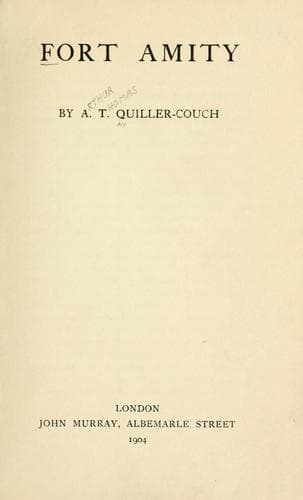
FORT AMITY.
BY
Arthur Thomas Quiller-Couch.
TO HENRY NEWBOLT.
My dear Newbolt,
Two schoolfellows, who had sat together in the Sixth at Clifton,
met at Paddington some twenty years later and travelled down to
enter their two sons at one school. On their way, while the boys
shyly became acquainted, the fathers discussed the project of this
story; a small matter in comparison with the real business of that
day--but that it happened so gives me the opportunity of dedicating
_Fort Amity_ to you, its editor in _The Monthly Review_, as a
reminder to outlast the short life granted in these days to novels.
Yet if either of our sons shall turn its pages some years hence,
though but to remind himself of his first journey to school, I hope
he will not lay it down too contemptuously. The tale has, for its
own purposes, so seriously confused the geography of Fort Amitie,
that he may search the map and end by doubting if any such fortress
ever existed and stood a siege: but I trust it will leave him in no
doubt of what his elders understood by honour and friendship.
Of these two themes, at any rate, I have composed it, and dedicate it
to a poet who has sung nobly of both. "Like to the generations of
leaves are those of men"--but while we last, let these deciduous
pages commemorate the day when we two went back to school four
strong. May they also contain nothing unworthy to survive us in our
two fellow-travellers!
A. T. QUILLER-COUCH.
The Haven, April 20th, 1904.
PREFACE.
More than once, attempting a story of high and passionate love--in
this book, for example, and still more recklessly in my tale of
_Sir John Constantine_--I have had to pause and ask myself the
elementary question: Can such a story, if at once true and exemplary,
conclude otherwise than in sorrow?
The great artists in poetry and prose fiction seem to consent that it
cannot: and this, I think, not because--understanding love as they
do, with all its wonder and wild desire--they would conduct it to
life-long bliss if they could, but simply because they cannot fit it
into this muddy vesture of decay. They may dismiss us in the end
with peace and consolation:
And calm of mind, all passion spent.
And we know or have known that of its impulse among us lesser folk it
holifies and populates this world. But our own transience qualifies
it. Only when love here claims to be above the world--"All for Love,
and the World well Lost"--we feel that its exorbitance must wreck it
here and now, however it may shine hereafter. That is why all the
great legends of love--the tale of Tristan and Iseult, for instance--
are unhappy legends: as that is why they still tease us.
Public-domain text, read in full here on John Shaqi.
Reviews
Reviews
No reviews yet
Be the first to share your thoughts on this work.
Join the Discussion
Join the discussion
Sign in to leave a comment or review.
Sign InorCreate an account