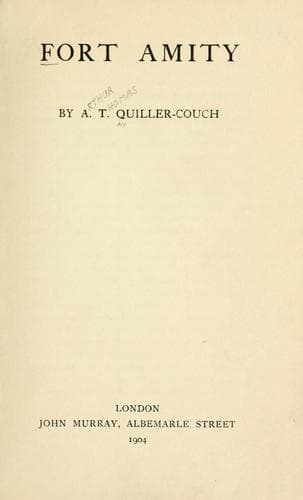
United States -- History -- French and Indian War, 1754-1763 -- Fiction
The take-off--a flat slab of rock--was good, and the leap well timed.
But he had allowed too little, perhaps, for his weariness and his
recent wound; and in the darkness he had not seen that of the two
brinks the far one stood the higher by many inches. In mid-air he
saw it, and flung his arms forward as he pitched against it little
more than breast-high. His fingers clutched vainly for hold, while
his toes scraped the face of the rock, but found no crevice to
support them.
Had his body dropped a couple of inches lower before striking the
bank, or had the ledge shelved a degree or two more steeply, or had
it been smooth or slippery with rain, he must have fallen backward
into the chasm. As it was, his weight rested so far forward upon his
arms that, pressing his elbows down upon the rock, he heaved himself
over on the right side of the balance, fell on his face and chest,
and so wriggled forward until he could lift a knee.
The roar of the waters drowned all other noise. Only that faint cry
of Barboux had followed him across. But now, as he scrambled to his
feet, he heard a sudden thud on the ledge behind him. A hand
clutched at his heel, out of the night. At once he knew that his
stratagem had failed, that Barboux would not fire, that Muskingon was
upon him. He turned to get at grips; but, in the act of turning,
felt his brain open and close again with a flame and a crash,
stretched out both arms, and pitched forward into darkness.
It seemed--for he knew no break in his sensations--that the ground,
as he touched it, became strangely soft and elastic. For a while he
wondered at this idly, then opened his eyes--but only to blink and
close them again, for they were met by broad daylight.
He was lying on the grass; he was resting in Muskingon's arms amid a
roaring of many waters; he was being carried between Muskingon and
Menehwehna beneath a dark roof of pines--and yet their boughs were
transparent, and he looked straight through them into blue sky.
Was he dead? Had he passed into a world where time was not, that all
these things were happening together? If so, how came the two
Indians here? And Barboux? He could hear Barboux muttering: no,
shouting aloud. Why was the man making such a noise? And who was
that firing? . . . Oh, tell him to stop! The breastwork will never
be carried in this way--haven't the troops charged it again and
again? Look at Sagramore, there: pull him off somebody and let him
die quiet! For pity's sake fetch the General, to make an end of this
folly! Forty-sixth! Where are the Forty-sixth? . . .
Public-domain text, read in full here on John Shaqi.
Reviews
Reviews
No reviews yet
Be the first to share your thoughts on this work.
Join the Discussion
Join the discussion
Sign in to leave a comment or review.
Sign InorCreate an account