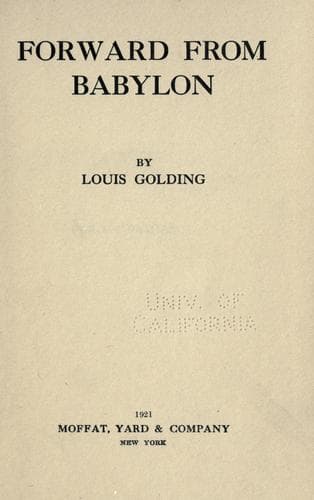
England, Northern -- Fiction; Fathers and sons -- Fiction; Jews -- Fiction
Reb Monash had felt hitherto that the child of his dreams, such a child
as would have been a living glory in Terkass, was almost of too
exquisite a lineament for the reality of this godless England. But
Mottele had undeceived him, for here in the very flesh was a child
actually born in England and yet recalling irresistibly the piety of
his own boyhood in Russia; a child such as he had been himself, at ten
years an intimate of greybeards and an object of almost superstitious
affection and reverence among the old women of the Synagogue. He would
not confess it to himself, yet there seemed an element of injustice in
the fact that he, Reb Monash, to whom surely, on the grounds of his own
holiness and the uninterrupted holiness of his ancestry generation
behind generation, such a son as Mottele was due, that he should be the
father of so unsatisfactory a child as Philip. There was much he loved
in Philip. Because of the very strength of his love for Philip, he
assured himself, he grieved so much to find Philip so far from his
heart's desire. It was as much a matter of the happiness of Philip's
own soul as of the happiness and credit of himself. But, he realized,
to display to Philip or to Philip's mother, how deep was his love for
his son, would be tantamount to an offence against God. It would
sanction the delusion that he accepted Philip such as he was, whereas
the Philip he strove after was far less like Philip than like himself
or Mottele, after which image, with God's grace, he would yet convert
his son. For there was much, he repeated, he loved in Philip; as for
instance his poetry, his imagination, which, wedded to Jewishness, the
spiritual state called _Yidishkeit_, were a valuable possession, as he,
in his oratory, himself frequently realized. On the other hand, the
quality of poetry, unhealthily developed, might nourish errors
concerning the primal verity of _Yidishkeit_ which might land him into
the pits of the unclean. There was a certain quality of the _rational_
which up to a certain limit was likewise a decoration. It was a
quality which could excellently elucidate a parable or examine an
obscure text with the possible result of throwing upon it a naive and
modern light very entertaining to the elders at the Synagogue; but
again, like all Philip's positive qualities, it had a negative aspect
of the greatest spiritual danger. It was a God-sent bounty that had
sent Mottele in his way--Mottele, who had imagination, but not to
excess, who was rational, but not unhealthily. By placing the virtues
of Mottele in a clear light before Philip, by the spectacle of the
affection and esteem which Mottele commanded in the exercise of these
virtues, both in _chayder_ and in _shool_, the increasing contumacy he
had observed with alarm in Philip would be broken down, and a son
worthy of the traditions of Reb Monash adorn his home.
Public-domain text, read in full here on John Shaqi.
Reviews
Reviews
No reviews yet
Be the first to share your thoughts on this work.
Join the Discussion
Join the discussion
Sign in to leave a comment or review.
Sign InorCreate an account