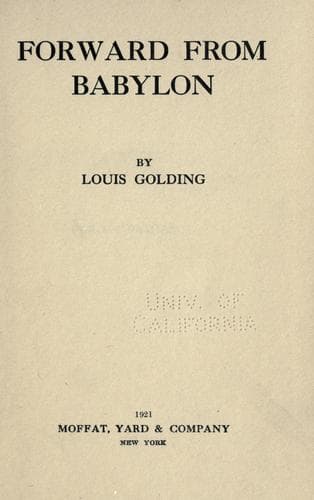
England, Northern -- Fiction; Fathers and sons -- Fiction; Jews -- Fiction
"The Place of Poetry in Cities," he began with anticipatory panache,
"is so great that it abolishes cities and turns the mud rivers into
rivers of silver. There is," he continued with anti-climax, "nothing
like it." But he soon resumed the tenour of his flight. Philip was,
in fact, affirming his creed, affirming the philosophy he had attained
after eleven and a half years of brick and mud, of stupidity, error,
false ideals, of that living poetry spelled by the half-hidden love
between his mother and himself, of that poetry in words which, without
this living poetry, could not have unfolded her secrets to a child
immersed in an almost unbroken despair. His pen scratched furiously
along. Too swiftly, too swiftly, the minutes raced round the rim of
his borrowed watch. Frequently the green meadows of his writing were
patined with flowers from the poets he had discovered, Campbell, Moore,
Tennyson, Longfellow, and when these failed him, an impromptu verse
from Philip Massel bubbled from his simmering brain. He was vaguely
conscious of the approach towards him of a clean-shaven man, with a
strong, red face, firm of jaw; but clad in such inexpensive clothing as
obviously to denote him the caretaker or, perhaps, the drilling
instructor. He was aware with a slight annoyance that the man hung for
some minutes over his paper and then very lightly placed his hand on
Philip's head. There was something quiet and fine and firm in that
gesture. Perhaps he wasn't the drilling instructor? Perhaps he was a
real master with a large family and he couldn't afford to wear
brand-new clothing? What did it matter? ... "so that the chimneys all
seem to be made of gold and the poor men are like princes...."
The stage arrived when he could no longer see the lines on which he was
writing or the letters he was forming. Still his pen raced along. The
tip of his pen disappeared in a mist like the top of a telegraph pole
in a November fog. His forehead was clammy with sweat. His forefinger
and thumb hurt horribly. And what was that? Some fool was clanging
the bell! That meant he must stop! Oh, the fool! Faster still and
faster! He felt that his eyes must fall from his sockets. Tears of
effort were rolling down his face. At last! At last! "... for Poetry
takes us from the cities of bricks and mud to a land full of beauty
like the night is full of stars!"
The dignitary of the receiving-desk by the door stared curiously at
him. He staggered out, half-blind, but filled with a great calm. The
days that followed were days of a confident lassitude. The decision
lay on the knees of the Rat and Mr. Furness, and he was content to wait.
When the information arrived that Philip Massel had won his
scholarship, Reb Monash buried Philip's head in his moustache and
beard. "Now," he said, his voice quivering, "thou wilt be a Jew and a
Human, a credit to God and Man!"
Public-domain text, read in full here on John Shaqi.
Reviews
Reviews
No reviews yet
Be the first to share your thoughts on this work.
Join the Discussion
Join the discussion
Sign in to leave a comment or review.
Sign InorCreate an account