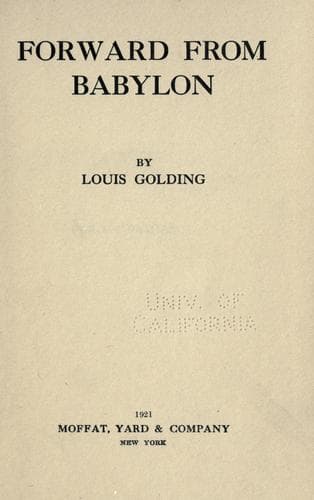
England, Northern -- Fiction; Fathers and sons -- Fiction; Jews -- Fiction
When Reb Monash fell into his best anecdotic form, Philip sometimes,
only a year or two ago, had been afraid to venture beyond the front
door, in fear of _Kossacken_ galloping in with drawn sabres from
Doomington Road. Indubitably the night was compact with their menace.
Only gradually he shook off these alarms. England, he realized, the
very filth of the Mitchen river impressing it upon him, and the grime
of these grassless, clangorous streets, England was not Russia--a
knowledge won only after thick agony and his brow soaked with midnight
terror. Russia--the first Babylon--the dread, the enmity, faded into
the murky Doomington skies.
One scene remained with him to consummate this nightmare. Reb Monash
told the story frequently. If he had played a part whereat women
lowered their respectful eyes with a fleeting gesture of disapproval or
impatience, his piety none the less was confirmed, if it needed
confirmation, in the eyes of the Lord Himself.
It was many years ago now, years before Philip was born. Reb Monash at
last was emigrating from Russia to the Western world. His family and
half a dozen other families had been packed into the uncovered
emigrants' cart which was to take them to the railway terminus many
leagues away, where they would entrain for Germany and Hamburg. It was
a matter of no interest to the authorities that at most a dozen people
could breathe comfortably and stretch their limbs in the vehicle they
provided. Family after family was bundled in, every half-foot of extra
space was crammed with bedding and the few household goods which, the
more cumbrous they were, they found the more indispensable.
Why, indeed, Reb Monash was emigrating he had not precisely satisfied
himself. Though fear of a _pogrom_ hovered ever on the horizon, a
cloud no bigger than a man's hand, but liable, any wind of prejudice
blowing, to streak the sky with more sanguine hues than sunset, this
had been beyond memory so much a normal feature of existence that it
could not have been the determining factor. If the traditional
_wanderlust_ animated him, he was too much in demand as an orator in
the synagogues hundreds of miles round Terkass to lack means to gratify
his instinct. It cannot have been the sentiment that young Jewry in
England and America (where he was intending to end his provisional
pilgrimage) had so far fallen from grace that it needed the example of
his physical presence before it could resume the narrow road; it can
hardly have been that--for such ungodliness as prevailed in England and
America needed to be seen before it could be imagined.
Public-domain text, read in full here on John Shaqi.
Reviews
Reviews
No reviews yet
Be the first to share your thoughts on this work.
Join the Discussion
Join the discussion
Sign in to leave a comment or review.
Sign InorCreate an account