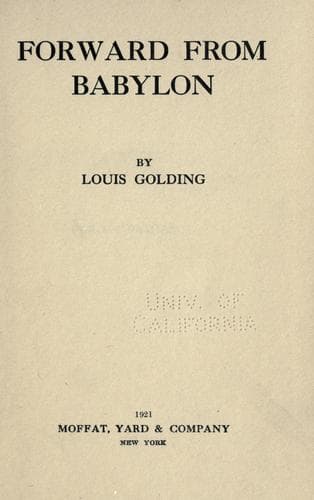
England, Northern -- Fiction; Fathers and sons -- Fiction; Jews -- Fiction
But the acceptance of a general diminution in the divine attributes,
through which the Godhead gradually became a vague half-credible
abstraction, was attended by a campaign much more injurious to Philip's
ease. His elders had approached God with as much terror as
understanding when they made any advances in the celestial direction.
It was reassuring to realize that if God was being divested of His
raiment of love, He was losing proportionately the lightning of His
jealousy and the bolt of His somewhat sectarian wrath. Yet
simultaneously, as Segal and Harry agreed with no apparent remorse, it
was imperative to abandon the immortality of the soul. To Philip there
was something homicidal, matricidal, in the facile way with which they
consigned to worms as their ultimate doom the folk whom they might be
expected to love most dearly. They admitted it was an unpleasant pill
to swallow, but in the wind of truth their personal predilections, they
avowed, were as chaff! Who were they to stand up against Logic,
against Law? "Truth the grand," a poet had said, "has blown my dreams
into grains of sand!"
Segal remained imperturbable amid the crash of boyish comfort and
illusion. His own extinction being the disintegration of a number of
acute faculties, there would be no wraith of frustrated passion and
insatiate hungers to move forlornly through the Godless void. There
was a keen, bright fascination in this self-sufficiency for both the
tempestuous utilitarianism of Harry and the inchoate poetry of Philip
for whom this friendship involved almost a pungent ecstasy of
self-extinction, like the repeated assault of the moth against the
poised, unreluctant flame. These conclusions plunged Harry into a more
fiery round of Socialistic activities than he had yet known. If the
oppressed classes of the world would in no future state achieve
equality, if the capitalists in no democracy of spirits would be set by
counter-balance to hew wood and draw water for wage slaves there
triumphant, all the more reason then to achieve an earthly Utopia, to
rouse young Doomington to a sense of its manifold wrongs and, in the
concrete, to stand as Socialist candidate for the coming parliamentary
election at the Highfield Grade School. Philip, on the other hand,
felt what happened in this miserable and abortive world hardly
mattered, when all its insignificant schemes were doomed, collectively
and individually, to sudden and absolute annihilation. The extinction
of souls was not an attractive philosophy, he reflected bitterly, but
there seemed no alternative but to accept it as a general truth. Not
wholly consciously and with a passionate stupidity he applied three
individual cases to the test of the general assertion; the survival of
Shelley's soul, his mother's and his own. What arguing could there be
about these three and, least of all, about Shelley's. His mother's
death and his own being so utterly incredible, so much _contra
Public-domain text, read in full here on John Shaqi.
Reviews
Reviews
No reviews yet
Be the first to share your thoughts on this work.
Elsewhere in the archive
Join the Discussion
Join the discussion
Sign in to leave a comment or review.
Sign InorCreate an account