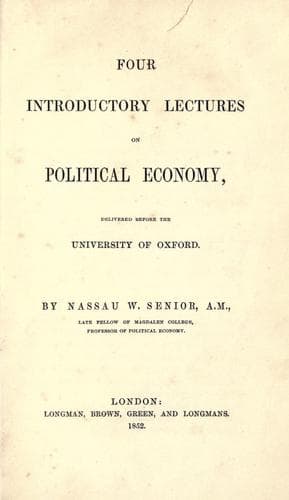
Four Introductory Lectures on Political EconomySenior, Nassau William
General
Four Introductory Lectures on Political Economy
Senior, Nassau William
Economics
FOUR
INTRODUCTORY LECTURES
ON
POLITICAL ECONOMY,
DELIVERED BEFORE THE
UNIVERSITY OF OXFORD.
BY NASSAU W. SENIOR, A.M.,
LATE FELLOW OF MAGDALEN COLLEGE,
PROFESSOR OF POLITICAL ECONOMY.
LONDON:
LONGMAN, BROWN, GREEN, AND LONGMANS.
1852.
LONDON:
SPOTTISWOODES and SHAW,
New-street-Square.
LECTURE I.
CAUSES THAT HAVE RETARDED THE PROGRESS OF POLITICAL ECONOMY.
Political Economy, as a separate branch of study, may be said to be
about a century old. Many of the facts which are its subject-matter,
have indeed attracted human attention from the earliest times; many
opinions, right or wrong, have been formed respecting them, and many
customs and laws, beneficial or injurious, have been the consequence:
but it was not until nearly the middle of the last century, that
any attempt was made to reduce those opinions into a system, or to
ascertain the grounds on which they were founded, or even how far they
were reconcilable with one another. To M. Quesnay belongs the honour of
having first endeavoured to explain of what wealth consists, by what
means it is produced, increased, and diminished, and according to what
laws distributed; in other words, of having been the first teacher of
Political Economy. In the course of his investigations, he found that
in the pursuit of wealth all governments had not merely mistaken the
straight road, but had frequently pursued a path leading directly away
from it. He found that instead of endeavouring to attain a beneficial
end by appropriate measures, they had been aiming at a useless result
by means totally ineffectual. Until his time it had been supposed that
wealth consists of gold and silver, and that the quantity of gold and
silver in any given country is to be increased by encouraging the
exportation and discouraging the importation of all other commodities,
and by the perpetual interference of governments in the modes in which
the labour of their subjects is exerted, and the objects to which it
is directed. Quesnay showed that gold and silver make the smallest
and least important portion of the wealth of a country. And he showed
that the abundance of gold and silver, and of every other commodity,
is to be promoted, not by restrictions on importation, nor by bounties
on exportation, but by the absolute freedom of external and internal
trade; by securing to every man the results of his industry or
frugality, without attempting to order him what to produce or how to
enjoy.
Public-domain text, read in full here on John Shaqi.
Reviews
Reviews
No reviews yet
Be the first to share your thoughts on this work.
Join the Discussion
Join the discussion
Sign in to leave a comment or review.
Sign InorCreate an account