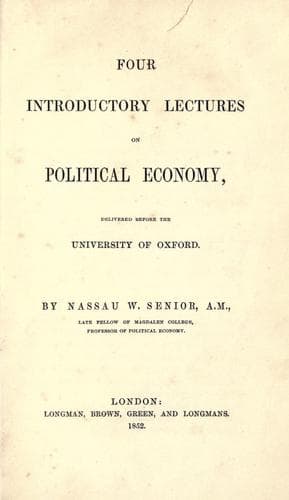
Four Introductory Lectures on Political EconomySenior, Nassau William
General
Four Introductory Lectures on Political Economy
Senior, Nassau William
Economics
If our laws had been of the unchangeable character which has been
ascribed to those of the Medes and Persians, we might have investigated
the nature and sources of wealth with the impartiality with which
we study the motions of the heavenly bodies. No one would have felt
himself interested in denying conclusions which would have been
unsusceptible of practical application. That wealth consists, not
of money, but of the things which money can purchase,--that it is
not lessened by resorting to the cheapest market,--that it is not
augmented by augmenting the nominal value of the tokens by which it
is measured,--that it increases with the increasing productiveness of
labour, and diminishes if more labour be required to produce a given
result,--that the profits of commerce consist not in what is given, but
in what is received, are propositions which might have been neglected
as truisms, or alluded to as self-evident, but could scarcely have been
made the subjects of eager controversy. Monopolies would never have
been defended, if monopolists had been secure.
It is to the difference in this respect in the state of Europe, that
I ascribe the difference in the degree of clamour which was raised
against Adam Smith in England, and the earlier economists in France,
and that which has been directed against their successors in both
countries. The doctrines of Quesnay and Smith were as much opposed to
existing abuses as those of Malthus or of Ricardo; but there did not
appear to be the same chance of their application. While restriction
and prohibition was the rule, and apparently the unalterable rule,
political economists were forgiven for proclaiming the advantages of
free trade. The theory was even admitted as long as the practice seemed
at a distance. But these halcyon times are over: it is becoming every
day more apparent, that whatever is generally believed to be expedient,
will sooner or later be attempted; and that institutions are to be
attacked and defended, not by force, but by argument,--not by mere
clamour, or dogged refusal, but by convincing the public of the benefit
or of the disadvantage of the proposed alteration.
Public-domain text, read in full here on John Shaqi.
Reviews
Reviews
No reviews yet
Be the first to share your thoughts on this work.
Join the Discussion
Join the discussion
Sign in to leave a comment or review.
Sign InorCreate an account