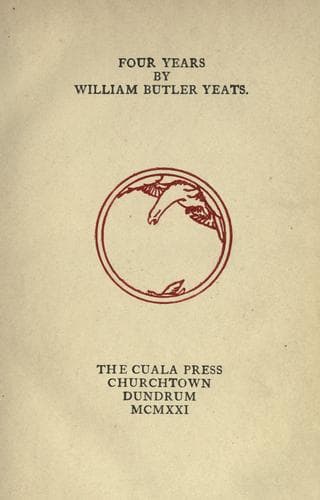
Poets, Irish -- 20th century -- Biography; Yeats, W. B. (William Butler), 1865-1939
I did not read economics, having turned socialist because of
Morris's lectures and pamphlets, and I think it unlikely that Morris
himself could read economics. That old dogma of mine seemed germane
to the matter. If the men and women imagined by the poets were the
norm, and if Morris had, in, let us say, 'News from Nowhere,' then
running through 'The Commonwealth,' described such men and women
living under their natural conditions or as they would desire to
live, then those conditions themselves must be the norm, and could
we but get rid of certain institutions the world would turn from
eccentricity. Perhaps Morris himself justified himself in his own
heart by as simple an argument, and was, as the socialist D... said
to me one night walking home after some lecture, 'an anarchist
without knowing it.' Certainly I and all about me, including D...
himself, were for chopping up the old king for Medea's pot. Morris
had told us to have nothing to do with the parliamentary socialists,
represented for men in general by the Fabian Society and Hyndman's
Socialist Democratic Federation and for us in particular by D...
During the period of transition mistakes must be made, and the
discredit of these mistakes must be left to 'the bourgeoisie;' and
besides, when you begin to talk of this measure or that other you
lose sight of the goal and see, to reverse Swinburne's description
of Tiresias, 'light on the way but darkness on the goal.' By
mistakes Morris meant vexatious restrictions and compromises--'If
any man puts me into a labour squad, I will lie on my back and
kick.' That phrase very much expresses our idea of revolutionary
tactics: we all intended to lie upon our back and kick. D..., pale
and sedentary, did not dislike labour squads and we all hated him
with the left side of our heads, while admiring him immensely with
the right. He alone was invited to entertain Mrs. Morris, having
many tales of his Irish uncles, more especially of one particular
uncle who had tried to commit suicide by shutting his head into a
carpet bag. At that time he was an obscure man, known only for a
witty speaker at street corners and in Park demonstrations. He had,
with an assumed truculence and fury, cold logic, an universal
gentleness, an unruffled courtesy, and yet could never close a
speech without being denounced by a journeyman hatter with an
Italian name. Converted to socialism by D..., and to anarchism by
himself, with swinging arm and uplifted voice this man perhaps
exaggerated our scruple about parliament. 'I lack,' said D..., 'the
bump of reverence;' whereon the wild man shouted 'You 'ave a 'ole.'
There are moments when looking back I somewhat confuse my own figure
with that of the hatter, image of our hysteria, for I too became
violent with the violent solemnity of a religious devotee. I can
even remember sitting behind D... and saying some rude thing or
other over his shoulder. I don't remember why I gave it up but I did
Public-domain text, read in full here on John Shaqi.
Reviews
Reviews
No reviews yet
Be the first to share your thoughts on this work.
Join the Discussion
Join the discussion
Sign in to leave a comment or review.
Sign InorCreate an account