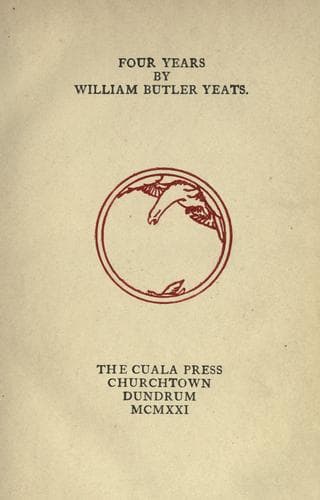
Poets, Irish -- 20th century -- Biography; Yeats, W. B. (William Butler), 1865-1939
He cried: 'Young A... has just been round to ask my advice. Would
I think it a wise thing if he bolted with Mrs. B...? "Have you
quite determined to do it?" I asked him. "Quite." "Well," I said,
"in that case I refuse to give you any advice."' Mrs. B... was a
beautiful talented woman, who, as the Welsh triad said of
Guinevere, 'was much given to being carried off.' I think we
listened to him, and often obeyed him, partly because he was quite
plainly not upon the side of our parents. We might have a
different ground of quarrel, but the result seemed more important
than the ground, and his confident manner and speech made us
believe, perhaps for the first time, in victory. And besides, if
he did denounce, and in my case he certainly did, what we held in
secret reverence, he never failed to associate it with things, or
persons, that did not move us to reverence. Once I found him just
returned from some art congress in Liverpool or in Manchester.
'The Salvation Armyism of art,' he called it, & gave a grotesque
description of some city councillor he had found admiring Turner.
Henley, who hated all that Ruskin praised, thereupon derided
Turner, and finding the city councillor the next day on the other
side of the gallery, admiring some Pre-Raphaelite there, derided
that Pre-Raphaelite. The third day Henley discovered the poor man
on a chair in the middle of the room, staring disconsolately upon
the floor. He terrified us also, and certainly I did not dare, and
I think none of us dared, to speak our admiration for book or
picture he condemned, but he made us feel always our importance,
and no man among us could do good work, or show the promise of it,
and lack his praise.
Public-domain text, read in full here on John Shaqi.
Reviews
Reviews
No reviews yet
Be the first to share your thoughts on this work.
Join the Discussion
Join the discussion
Sign in to leave a comment or review.
Sign InorCreate an account