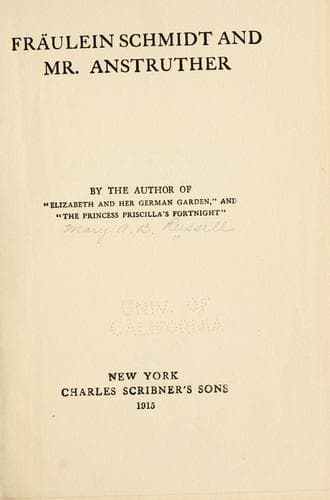
Fräulein Schmidt and Mr. AnstrutherVon Arnim, Elizabeth
General
Fräulein Schmidt and Mr. Anstruther
Von Arnim, Elizabeth
British -- Germany -- Fiction; Epistolary fiction; Germany -- Fiction; Love stories; Young women -- Fiction
Well, here are these people freezing us into what they consider our
proper place whenever we come across them, taking no pains to hide what
undesirable beings we are in their sight, staring at Papa's hat in
eloquent silence when it is more than usually tilted over one ear,
running eyes that chill my blood over my fustian clothes--I'm not sure
what fustian is, but I'm quite sure my clothes are made of it--oddly
deaf when we say anything, oddly blind when we meet anywhere unless we
actually run into them, here they are, doing all these things every day
with a repeated gusto, and with no reason whatever that I can see to
support their pretensions. Is it so wonderful to be a _von_? For that is
all, look as I will, that I can see they have to go on. They are poor,
as the retired officer invariably is, and they spend much time
pretending they are not. They know nothing; he has spent his best years
preoccupied with the routine of his calling, which leaves no room for
anything approaching study or interest in other things, she in bringing
up her son, also an officer, and in taking her daughter to those parties
in Berlin that so closely resemble, I gather from the girl Vicki's talk,
the parties in Jena--a little wider, a little more varied, with more
cups and glasses, and with, of course, the chance we do not have in Jena
of seeing some one quite new, but on the whole the same. He is a solemn
elderly person in a black-rimmed _pince-nez_, dressed in clothes that
give one the impression of always being black. He vegetates as
completely as any one I have ever seen or dreamed of. Prolonged coffee
in the morning, prolonged newspaper-reading, and a tortoise-like turn in
the garden kill his mornings. Dinner, says Vicki, kills another hour and
a half; then there is what we call the Dinner Sleep on the sofa in his
darkened room, and that brings him to coffee time. They sit over the
cups till Vicki wants to scream, at least she wants to since she has
known me, she says; up to then, after her miserable affair, she sat as
sluggishly as the others, but huddled while they were straight, and
red-eyed, which they were not. After coffee the parents walk up the road
to a certain point, and walk back again. Then comes the evening paper,
which he reads till supper-time, and after supper he smokes till he goes
to bed.
'Why, he's hardly alive at all,' I said to Vicki, when she described
this existence.
She shrugged her shoulders. 'It's what they all do,' she said, 'all the
retired. I've seen it a hundred times in Berlin. They're old, and they
never can start anything fresh.'
'We won't be like that when we're old, will we?' I said, gazing at her
wide-eyed, struck as by a vision.
She gazed back into my eyes, misgiving creeping, into hers. 'Sleep, and
eat, and read the paper?' she murmured.
'Sleep, and eat, and read the paper?' I echoed.
Public-domain text, read in full here on John Shaqi.
Reviews
Reviews
No reviews yet
Be the first to share your thoughts on this work.
Elsewhere in the archive
Join the Discussion
Join the discussion
Sign in to leave a comment or review.
Sign InorCreate an account