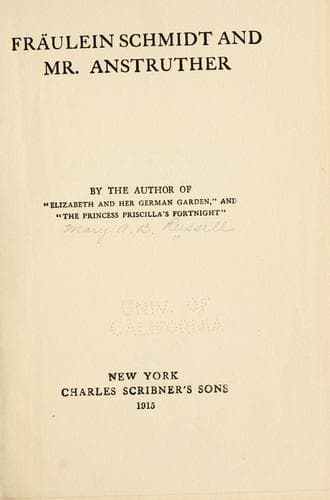
Fräulein Schmidt and Mr. AnstrutherVon Arnim, Elizabeth
General
Fräulein Schmidt and Mr. Anstruther
Von Arnim, Elizabeth
British -- Germany -- Fiction; Epistolary fiction; Germany -- Fiction; Love stories; Young women -- Fiction
ever want to marry me now, because I have been engaged.'
Well, love is a cruel, horrible thing. Hardly ever do both the persons
love with equal enthusiasm, and if they do what is the use? It is all
bound to end in smoke and nothingness, put out by the steady drizzle of
marriage. And for the others, for the masses of people who do not love
equally, of whom one half is at a miserable disadvantage, at the mercy
absolutely of the other half, what is there but pain in the end? And
yet--and yet it is a pretty thing in its beginnings, a sweet, darling
thing. But, like a kitten, all charm and delicious ways at first,
innocent, soft, enchanting, it turns into a cat with appalling rapidity
and cruelly claws you. I'd like to know if there's a single being on
earth so happy and so indifferent that he has not got hidden away
beneath a brave show of clothes and trimmings the mark of Love's claws.
And I think most of the clawings are so ferocious that they are for a
long time ghastly tears that open and bleed again; and when with years
they slowly dry up there is always the scar, red and terrible, that
makes you wince if by any chance it is touched. That is what I think.
What do you think?
Good-by.
No, don't tell me what you think. I don't want to know.
XLVI
Galgenberg, Sept. 24th.
Dear Mr. Anstruther,--Yesterday I was so much absorbed by Vicki's woes
that I never got to what I really wanted to write about. It's that book
I found in the Jena bookshop. It was second-hand and cheap, and I bought
it, and it has unkindly revenged itself by playing havoc with my
illusions. It is a collection of descriptions of what is known of the
lives of the English poets, beginning with Chaucer, who is luckily too
far away to provide much tattle, and coming down the centuries growing
bigger with gossip as it comes, till it ends with Rossetti, and
FitzGerald, and Stevenson. Each poet has his portrait. It was for that I
bought it. I cannot tell you how eagerly I looked at them. At last I was
going to see what Wordsworth looked like, and Coleridge, and Keats, and
Shelley. One of my dreams has been to go to that National Portrait
Gallery of yours in London, described in an old Baedeker I once saw, and
gaze at the faces of those whose spirits I know so well. Now I don't
want to. Can you imagine what it is like, what an extremely blessed
state it is, only to have read the works of a poet, the filtered-out
best of him, and to have lived so far from his country and from
biographies or collections of his letters that all gossip about his
private life and criticisms of his morals are unknown to you? Milton,
Wordsworth, Keats, Shelley, Burns, have been to me great teachers, great
examples, before whose shining image, built up out of the radiant
materials their works provided, I have spent glorious hours in worship.
Not a cloud, not a misgiving has dimmed my worship. We need
altars--anyhow we women do--and they were mine--I have not been able to
Public-domain text, read in full here on John Shaqi.
Reviews
Reviews
No reviews yet
Be the first to share your thoughts on this work.
Elsewhere in the archive
Join the Discussion
Join the discussion
Sign in to leave a comment or review.
Sign InorCreate an account