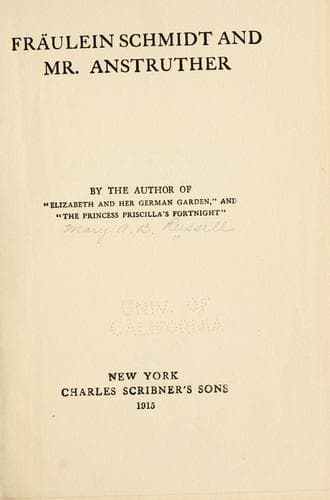
Fräulein Schmidt and Mr. AnstrutherVon Arnim, Elizabeth
General
Fräulein Schmidt and Mr. Anstruther
Von Arnim, Elizabeth
British -- Germany -- Fiction; Epistolary fiction; Germany -- Fiction; Love stories; Young women -- Fiction
Papa popped out his head again. 'You may believe me, Rose-Marie,' he
said.
'I do, Papachen,' said I.
'You have to thank me for much.'
'And I do,' said I heartily, smiling up at him.
'But for nothing more than for leaving you free to put forth such shoots
as your nature demanded in whatever direction your instincts propelled
you.' And he disappeared and shut the window.
Vicki looked at me doubtfully. 'You said beautiful things,' she said,
'and he said just the opposite. Which is true?'
'Both,' said I promptly, determined not to be outdone as a prophet by
Papa.
Poor Vicki. It is so hard to have life turned into a smudge when one is
only twenty. She adored this man, was so proud of him, so proud of
herself for being chosen by him. She grew, in the year during which they
were engaged, into a woman, and can never now retrace her steps back to
that fairy place of sunshine and carelessness in which we so happily
wander if we are left alone for years and years after we are supposed to
be grown up. Do you realize what a blow in the face she has received, as
well as in her unfortunate little heart? All her vanities, without which
a girl is but a poor thing, shrivelled up, her self-respect gone, her
conceit, if there was any, and I suppose there was because there always
is, gone headlong after it. A betrothal here is almost as binding and
quite as solemn as a marriage. It is announced in the papers. It is
abundantly celebrated. And the parents on both sides fall on each
other's necks and think highly of one another till the moment comes for
making settlements. The Lindebergs spent all they had laid by and
borrowed more to buy the trousseau and furnish the house. Vicki cried
bitterly when she talked of her table-napkins. She says there were
twelve dozen in twelve different patterns, and each twelve was tied up
with a pink ribbon fastened by a buckle and a bow. They had to be sold
again at a grievous loss, and the family fled from Berlin and the faces
of their acquaintances, faces crooked with the effort to sympathize when
what they really wanted to do, says Vicki, was to smile, and came to
this cheap place where they can sit in obscurity darning up the holes in
their damaged fortunes. Frau von Lindeberg, who has none of the torment
of rejected love to occupy her feelings and all the bitterness of the
social and financial blow, cannot help saying hard things to Vicki,
things pointed and poisoned with reproaches that sometimes almost verge
on taunts. The man was a good _parti_ for Vicki; little money, but much
promise for the future, a good deal older than herself and already
brilliant as an officer; and during the engagement the satisfied mother
overflowed, as mothers will, with love for the creditable daughter. 'It
was so nice,' said Vicki-, dolefully sniffing. 'She seemed to love me
almost as much as she loves my brother. I was so happy. I had so much.
Then everything went at once. Mamma can't bear to think that no one will
Public-domain text, read in full here on John Shaqi.
Reviews
Reviews
No reviews yet
Be the first to share your thoughts on this work.
Elsewhere in the archive
Join the Discussion
Join the discussion
Sign in to leave a comment or review.
Sign InorCreate an account