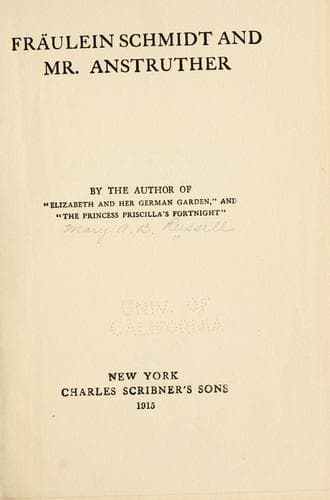
Fräulein Schmidt and Mr. AnstrutherVon Arnim, Elizabeth
General
Fräulein Schmidt and Mr. Anstruther
Von Arnim, Elizabeth
British -- Germany -- Fiction; Epistolary fiction; Germany -- Fiction; Love stories; Young women -- Fiction
as you do a precious shelf-full of the poets, cheap editions, entirely
free from the blight of commentaries, foot-notes, and introductory
biographies. And suppose these books in the course of years have become
your religion, your guide, the source of your best thoughts and happiest
moments--would you look on placidly while some one scrawled malicious
truths between their lines? Oh, you would not. You would feel as I do.
Think what the writers are to me, how I have built up their
personalities entirely out of the materials they gave me in their work.
They never told me horrid things about themselves. Their spirits, which
alone they talked about, were serene and white. I knew Milton was blind,
because he chose beautifully to tell me so. I knew he must have been an
appreciative and regretful husband, because no husband who did not
appreciate and regret would go so far as to talk of his deceased wife as
his late espoused saint. I knew he was a tender friend, a friend capable
of deepest love and sorrow, for in spite of Johnson's 'It is not to be
considered as the effusion of real passion,' I was convinced by the love
and sorrow of 'Lycidas.' I knew he was a man whose spirit was dissolved
continually into the highest ecstasies, who lived with all heaven before
his eyes,--briefly, I said Amen to Wordsworth's 'His soul was like a
star, and dwelt apart.' And now a series of sordid little pictures rises
up before me and chokes my Amen. I cannot bear to think of him having
two or three olives for supper and a little cold water, and then being
cross to his daughters. Of course he must be cross on such a supper. I
can't conceive it kind to drill the daughters so strictly in languages
they did not understand that they could read them aloud to him with
extraordinary correctness. I shrink from the thought of the grumbling
there was in that house of heavenly visions, grumbling and squabbling
stamped out, it is true, by the heavy parental foot wherever noticed,
but smouldering on from one occasion to the other. I cannot believe--I
wish I could--that a child will dislike a parent without cause; the
cause may be small things, a series of trifles each of little moment,
snubs too often repeated, chills too often applied, stern looks, short
words, sarcasms,--and these, as you and I both know, are quite ordinary
dulnesses, often daily ingredients of family life; but they sit with a
strange and upsetting grace on the poet of Paradise, and I would give
anything never to have heard of them.
Public-domain text, read in full here on John Shaqi.
Reviews
Reviews
No reviews yet
Be the first to share your thoughts on this work.
Elsewhere in the archive
Join the Discussion
Join the discussion
Sign in to leave a comment or review.
Sign InorCreate an account