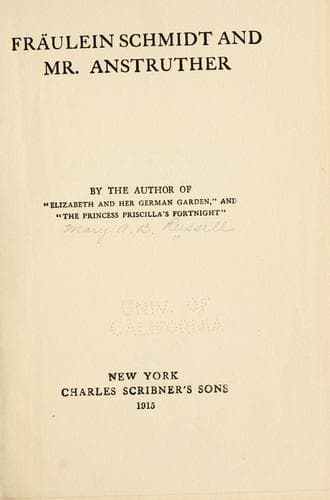
Fräulein Schmidt and Mr. AnstrutherVon Arnim, Elizabeth
General
Fräulein Schmidt and Mr. Anstruther
Von Arnim, Elizabeth
British -- Germany -- Fiction; Epistolary fiction; Germany -- Fiction; Love stories; Young women -- Fiction
And then you know I loved FitzGerald. He had one of my best altars. You
remember you read _Omar Khayyam_ twice aloud to me--once in the spring
(it was the third of April, a sudden hot day, blue and joyous, slipped
in to show God had not forgotten us between weeks of hopeless skies and
icy winds) and once last September, that afternoon we drifted down the
river past the town, away from houses and people and work and lessons,
out to where the partridges scuttled across the stubble and all the
world was golden. (That was the eleventh of September; I am rather good,
you see, at dates.) Well, now I call him Fitz, and laugh at the
description of him going about Suffolk lanes in a battered tall hat tied
on in windy weather by a handkerchief, and trailing behind him, instead
of clouds of glory, a shawl of green and black plaid. It isn't, of
course, in any way a bad thing to trail shawls after you on country
walks; there is nothing about it or him that shocks or grieves; he is
very lovable. But I don't want to laugh. I don't want to call him Fitz.
He is one of the gods in my temple, a place from which I rigorously
exclude the sense of humor. I don't like gods who are amusing. I cannot
worship and laugh simultaneously. I know that laughter is good, and I
know that even derision in small quantities is as wholesome as salt; but
I like to laugh and deride outside holy places, and not be forced to do
it while I am on my knees.
Now don't say What on earth does the woman want? because it seems to me
so plain. What the woman wants is that present and future poets should
wrap themselves sternly in an impenetrable veil of anonymity. They
won't, but she can go on praying that they will. They won't, because of
the power of the passing moment, because of the pleasantness of praise,
of recognition, of personal influence, and, I suppose, but I'm not sure,
of money. Do you remember that merry rhymer Prior, how he sang
'Tis long ago
Since gods came down incognito?
Well, I wish with all my heart they had gone on doing it a little
longer. He wasn't, I think, deploring what I deplore, the absence of a
sense for the anonymous in gods, of a sense of the dignity of
separation, of retirement, of mystery, wherever there is even one spark
of the Divine; I think he thought they had all been, and that neither
incognito nor in any other form would they appear again. He implied, and
so joined himself across the centuries to the Walrus and the Carpenter,
that there were no gods to come. Well, he has been dead over a hundred
and eighty years, and they have simply flocked since then. I'd like to
write the great names on this page, the names of the poets, first and
greatest of the gods, to raise it to dignity and confound the ghost of
Prior, but I won't out of consideration for you.
Public-domain text, read in full here on John Shaqi.
Reviews
Reviews
No reviews yet
Be the first to share your thoughts on this work.
Elsewhere in the archive
Join the Discussion
Join the discussion
Sign in to leave a comment or review.
Sign InorCreate an account