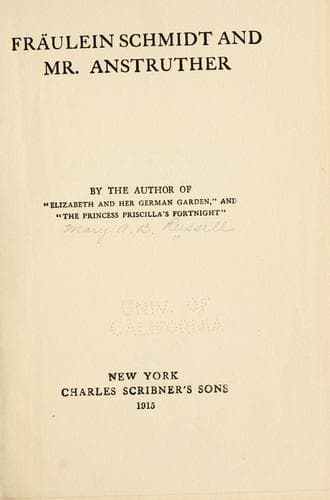
Fräulein Schmidt and Mr. AnstrutherVon Arnim, Elizabeth
General
Fräulein Schmidt and Mr. Anstruther
Von Arnim, Elizabeth
British -- Germany -- Fiction; Epistolary fiction; Germany -- Fiction; Love stories; Young women -- Fiction
The church is very ancient and dates from the thirteenth century. You
would like its outside--I wonder if in your walks you ever came
here--but its inside has been spoilt by the zealous Lutherans and turned
into the usual barn. In its first state of beauty in those far-off
Catholic days what a haven it must have been for all the women and most
of the men of that lonely turnip-growing village; the one beauty spot,
the one place of mystery and enthusiasm. No one, I thought, staring
about me, could possibly have their depths stirred in the middle of so
much whitewash. The inhabitants of these bald agricultural parishes are
not sufficiently spiritual for the Lutheran faith. Black gowns and
bareness may be enough for those whose piety is so exalted that
ceremonies are only a hindrance to the purity of their devotions; but
the ignorant and the dull, if they are to be stirred, and especially the
women who have entered upon that long series of gray years that begins,
for those worked gaunt and shapeless in the fields, somewhere about
twenty-five and never leaves off again, if they are to be helped to be
less forlorn need many ceremonies, many symbols, much show, and mystery,
and awfulness. You will say that it is improbable that the female
inhabitants of such a poor parish should know what it is to feel
forlorn; but I know better. You will, turning some of my own words
against me, tell me that one does not feel forlorn if one is worked hard
enough; but I know better about that too,--and I said it only in
reference to young men like yourself. It is true the tragedy of the
faded face combined with the uncomfortably young heart, which is the
tragedy that every woman who has had an easy life has to endure for
quite a number of years, finds no place in the existence of a drudge; it
is true too that I never yet saw, and I am sure you didn't, a woman of
the laboring classes make efforts to appear younger than she is; and it
is also true that I have seldom seen, and I am sure you haven't, women
of the class that has little to do leave off making them. Ceaseless hard
work and the care of many children do away very quickly with the youth
both of face and heart of the poor man's wife, and with the youth of
heart go the yearnings that rend her whose heart, whatever her face may
be doing, is still without a wrinkle. But drudgery and a lost youth do
not make your life less, but more dreary. These poor women have not,
like their husbands, the solace of the public-house _Schnapps_. They go
through the bitterness of the years wholly without anæsthetics. Really I
don't think I can let you go on persisting that they feel nothing. Why,
we shall soon have you believing that only you in this groaning and
travailing creation suffer. Please divest yourself of these illusions.
Read, my young friend, read the British poet Crabbe. Read him much;
ponder him more. He knew all about peasants. He was a plain man, with a
Public-domain text, read in full here on John Shaqi.
Reviews
Reviews
No reviews yet
Be the first to share your thoughts on this work.
Elsewhere in the archive
Join the Discussion
Join the discussion
Sign in to leave a comment or review.
Sign InorCreate an account