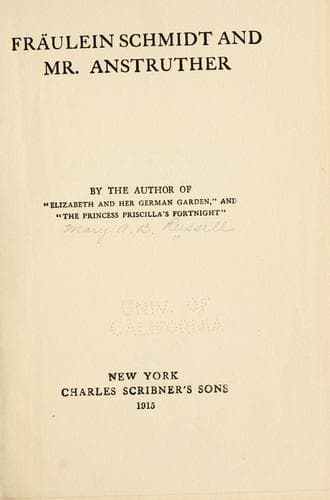
Fräulein Schmidt and Mr. AnstrutherVon Arnim, Elizabeth
General
Fräulein Schmidt and Mr. Anstruther
Von Arnim, Elizabeth
British -- Germany -- Fiction; Epistolary fiction; Germany -- Fiction; Love stories; Young women -- Fiction
the effect was to send me out singing into the garden and to start me
mending the fence. The neighbor came up to see what the vigorous
hammer-strokes and snatches of _Siegfried_ could mean, and when he saw
it was I immediately called out, 'You have been eating meat!'
'I have not,' I said, swinging my hammer to show what eggs and milk can
do.
'In some form or other you have this day joined yourself to the animal
kingdom,' he persisted; and when I told him about my breakfast he wiped
his hands (he had been picking fruit) and shook mine and congratulated
me. 'I have watched with concern,' he said, 'your eyes becoming daily
bigger. It is not good when eyes do that. Now they will shrink to their
normal size, and you will at last set your disgraceful garden in order.
Are you aware that the grass ought to have been made into hay a month
ago?'
He is a haggard man, thin of cheek, round of shoulder, short of sight,
who teaches little boys Latin and Greek in Weimar. For thirty years has
he taught them, eking out his income in the way we all do in these parts
by taking in foreigners wanting to learn German. In July he shakes Eis
foreigners off and comes up here for six weeks' vacant pottering in his
orchard. He bought the house as a speculation, and lets the upper part
to any one who will take it, living himself, with his wife and son, on
the ground floor. He is extremely kind to me, and has given me to
understand that he considers me intelligent, so of course I like him.
Only those persons who love intelligence in others and have doubts about
their own know the deliciousness of being told a thing like that. I
adore being praised. I am athirst for it. Dreadfully vain down in my
heart, I go about pretending a fine aloofness from such weakness, so
that when nobody sees anything in me--and nobody ever does--I may at
least make a show of not having expected them to. Thus does a girl in a
ball-room with whom no one will dance pretend she does not want to. Thus
did the familiar fox conduct himself toward the grapes of tradition.
Very well do I know there is nothing to praise; but because I am just
clever enough to know that I am not clever, to be told that I am
clever--do you follow me?--sets me tingling.
Public-domain text, read in full here on John Shaqi.
Reviews
Reviews
No reviews yet
Be the first to share your thoughts on this work.
Elsewhere in the archive
Join the Discussion
Join the discussion
Sign in to leave a comment or review.
Sign InorCreate an account