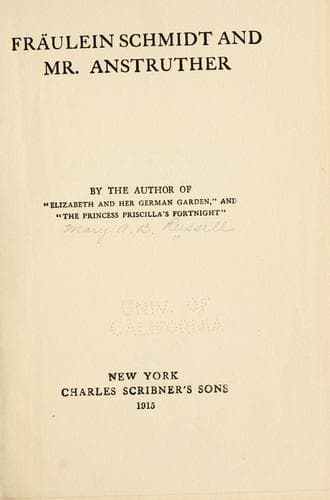
Fräulein Schmidt and Mr. AnstrutherVon Arnim, Elizabeth
General
Fräulein Schmidt and Mr. Anstruther
Von Arnim, Elizabeth
British -- Germany -- Fiction; Epistolary fiction; Germany -- Fiction; Love stories; Young women -- Fiction
On the other hand, wouldn't my speech become archaic? I'm afraid I would
have a tendency that would grow to address Papa in blank verse. My
language, even when praying him at breakfast to give me butter, would be
incorrigibly noble. I don't think Papa would like it. And what would he
say to a daughter who was forced by stress of concentration on six works
to go through life without Goethe? Goethe, you observe, was not one of
the two less glorious and he certainly was not one of the four
completely glorious. I begin to fear I should miss a great deal by my
exclusions. It would be sad to die without ever having been thrilled by
_Werther_, exalted by _Faust_, amazed by the _Wahlverwandtschaften_,
sent to sleep by _Wilhelm Meister_. To die innocent of any knowledge of
Schiller's _Glocke_, with no memory of strenuous hours spent getting it
by heart at school, might be quite pleasant. But I think it would end by
being tiring to be screwed up perpetually to the pitch of the greatest
men's greatest moments. Such heights are not for insects like myself. I
would hang very dismally, with drooping head and wings, on those exalted
hooks. And has not the soul too its longings at times for a
dressing-gown and slippers? And do you see how you could do without
Boswell?
Yours sincerely,
ROSE-MARIE SCHMIDT.
XLII
Galgenberg, Aug. 31st.
Dear Mr. Anstruther,--Yes, of course he does. He plays every evening.
And every evening I go and listen, either in the orchard beneath the
open window or, more ceremoniously, inside the room with or without
Papa. I find it a pleasant thing. I am living in a bath of music. And I
hope you don't expect me to agree with your criticism of music as a
stirrer-up of, on the whole, second-rate emotions. What are second-rate
emotions? Are they the ones that you have? And was it to have them
stirred that you used to journey so often to Munich and Mottl? Stirred
up I certainly am. Not in the way, I admit, in which a poem of Milton's
does it, not affected in the least as I am affected by, for instance,
the piled-up majesty of the poem on _Time_, but if less nobly still very
effectually. There; I have apparently begun to agree with you. Well, I
do see, the moment I begin to consider, that what is stirred is less
noble. I do see that what I feel when I listen to music is chiefly
_Wehmuth_, and I don't think much of _Wehmuth_. You have no word for it.
Perhaps in England you do not have just that form of sentiment. It is a
forlorn thing, made up mostly of vague ingredients,--vague yearnings,
vague regrets, vague dissatisfactions. When it comes over you, you
remember all the people who are absent, and you are sad; and the people
who are dead, and you sigh; and the times you have been naughty, and you
groan. I do see that a sentiment that makes you do that is not the
highest. It is profitless, sterile. It doesn't send you on joyfully to
the next thing, but keeps you lingering in the dust of churchyards,
Public-domain text, read in full here on John Shaqi.
Reviews
Reviews
No reviews yet
Be the first to share your thoughts on this work.
Elsewhere in the archive
Join the Discussion
Join the discussion
Sign in to leave a comment or review.
Sign InorCreate an account