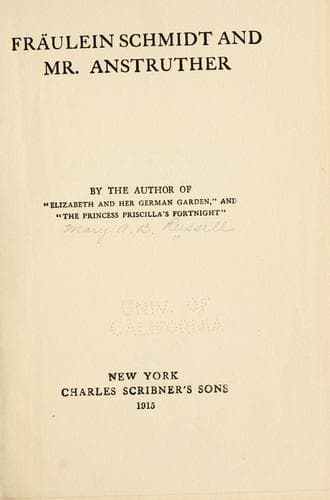
Fräulein Schmidt and Mr. AnstrutherVon Arnim, Elizabeth
General
Fräulein Schmidt and Mr. Anstruther
Von Arnim, Elizabeth
British -- Germany -- Fiction; Epistolary fiction; Germany -- Fiction; Love stories; Young women -- Fiction
barren places of the past which should never be revisited by the
wholesome-minded. Now this looks as though I were agreeing with you
quite, but I still don't. You put it so extremely. It is so horrid to
think that even my emotions may be second-rate. I long ago became aware
that my manners were so, but I did like to believe there was nothing
second-rate about my soul. Well, what is one to do? Never be soft? Never
be sad? Or sorry? Or repentant? Always stay up at the level of Milton's
_Time_ poem, or of his _At a Solemn Musick_, strung high up to an
unchanging pitch of frigid splendor and nobleness? It is what I try to
aim at. It is what I would best like. Then comes our friend of the red
tie, and in the cool of the day when the world is dim and scented shakes
a little fugue of Bach's out of his fiddle, a sparkling, sly little
fugue, frolicsome for all its minor key, a handful of bright threads
woven together, twisted in and out, playing, it would seem, at some game
of hide-and-seek, of pretending to want to catch each other into a
tangle, but always gayly coming out of the knots, each distinct and
holding on its shining way till the meeting at the end, the final
embrace when the game is over and they tie themselves contentedly
together into one comfortable major chord,--our friend plays this, this
manifestly happy thing, and my soul listens, and smiles, and sighs, and
longs, and ends by being steeped in _Wehmuth_. I choose the little fugue
of Bach as an instance, for of all music it is aimed most distinctly at
the intellect, it is the furthest removed from _Wehmuth_; and if it has
this effect on me I will not make you uncomfortable by a description of
what the baser musics do, the musics of passion, of furious exultations
and furious despairs. But my vague wish for I do not know what, gentle,
and rather sweetly resigned when the accompaniment is Bach, swells
suddenly while I listen to them into a terrifying longing that rends and
shatters my soul.
What private things I tell you. I wouldn't if I were talking. I would be
affected by your actual presence. But writing is so different, and so
strange; at once so much more and so much less intimate. The body is
safe--far away, unassailable; and the spirit lets itself go out to meet
a fellow spirit with the frankness it can never show when the body goes
too, that grievous hinderer of the communion of saints, that officious
blunderer who can spoil the serenest intercourse by a single blush.
Public-domain text, read in full here on John Shaqi.
Reviews
Reviews
No reviews yet
Be the first to share your thoughts on this work.
Elsewhere in the archive
Join the Discussion
Join the discussion
Sign in to leave a comment or review.
Sign InorCreate an account