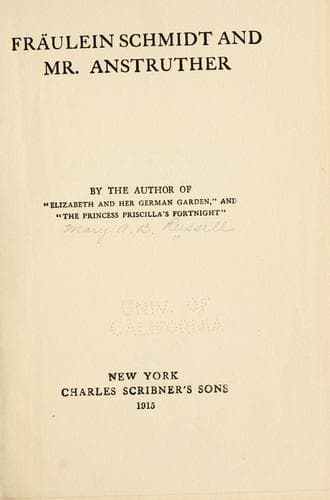
Fräulein Schmidt and Mr. AnstrutherVon Arnim, Elizabeth
General
Fräulein Schmidt and Mr. Anstruther
Von Arnim, Elizabeth
British -- Germany -- Fiction; Epistolary fiction; Germany -- Fiction; Love stories; Young women -- Fiction
His father was in the passage, walking up and down it, his hands in his
pockets, his shoulders up to his ears as though he were shrinking from
blows. He told me what his unhappy son had done. Not able to endure the
trumpet when it was being blown up at our house earlier in the evening,
not able to endure it even softened, chastened, subdued by distance and
the intervening walls, he had directed his mother to go up and invite
the player down to her kitchen, where he was to be cajoled into eating
and drinking, because, as the son explained, full of glee at his
sagacity, no man who is eating and drinking can at the same time be
blowing a trumpet. 'Thus,' said his father, in jerks coincident with the
breath-takings of the trumpeter, 'did he hope to obtain peace.'
'But he didn't,' said I.
'No. For a period there was extreme, delicious quiet. Mother'--so he
invariably describes his wife--' sacrificed her best sausage, for how
shall we permit our son to be tortured? The bread was spread with butter
three centimeters deep. The trumpeter and his _Schatz_ sat quietly in
the kitchen eating it. We sat quietly on the veranda discussing great
themes. Then that good beer my son so often praises, that excellent,
barrel-kept, cellar-lodged Pilsner beer, bright as amber, clear as ice,
cool as--cool as--'
'A cucumber,' I assisted.
'Good. Very good. As a cucumber--as a salad of cucumbers.'
'No, no--there's pepper in a salad. You'd better just keep to plain
cucumber,' I interrupted, always rather nice in the matter of images.
'Cool, then, as plain cucumber--this usually admirable stuff instead of,
as we had expected, sending him gradually and pleasantly to sleep--I
mean, of course, making him gradually and pleasantly so sleepy that
thoughts of his bed, growing in affection with every glass, would cause
him to arise and depart to his barracks,--woke him up. And, my dear
Fräulein, you yourself heard--you are hearing now--how completely it did
it.'
'Is he--is he--?' I inquired nervously.
The neighbor nodded. 'He is,' he said; 'he has consumed fourteen
glasses.'
And indeed he was; and I should say from the tumult, from the
formlessness of it, the tunelessness, the rollicksomeness, that never
was anybody more so.
'I fear my son will leave us for some quieter spot before his holiday is
over,' said the neighbor, looking distressed.
And perhaps it will convince you more than anything else I have said of
the extreme value of our Johannas, when I tell you that, goaded by the
noise and by his disappointed face to rash promises, I declared I would
dismiss the girl unless she broke off such an engagement, and he stared
at me for a moment in astonishment and then resignedly shook his head
and said with the weary conviction of a householder of thirty years'
standing, '_Das geht doch nicht._'
Yours sincerely,
ROSE-MARIE SCHMIDT.
XLIII
Galgenberg, Sept. 9th.
Public-domain text, read in full here on John Shaqi.
Reviews
Reviews
No reviews yet
Be the first to share your thoughts on this work.
Elsewhere in the archive
Join the Discussion
Join the discussion
Sign in to leave a comment or review.
Sign InorCreate an account