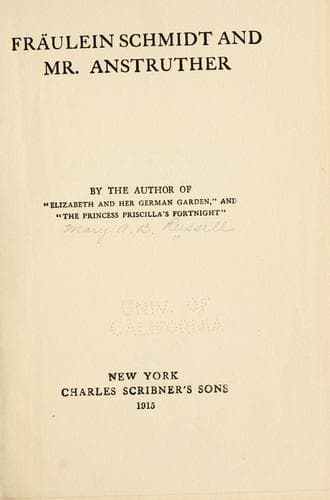
Fräulein Schmidt and Mr. AnstrutherVon Arnim, Elizabeth
General
Fräulein Schmidt and Mr. Anstruther
Von Arnim, Elizabeth
British -- Germany -- Fiction; Epistolary fiction; Germany -- Fiction; Love stories; Young women -- Fiction
Isn't that what happens to all you wise men, so prudently determined to
make your way in the world? You must be very sure of another life, or
how could you bear to squander this? The things you are missing--oh, the
things you are missing!--while you so carefully add little gain to
little gain, or what I would rather call little loss to little loss. I
see no point in slaving day after day through one's best years. Suppose
you do not, in the end, have a footman to open your door--the footman
is merely a symbol, conveniently expressing the multitude of
superfluities that gather about the declining years of the person who
has got on, things bought with the sacrifice of his life, and none of
them giving him back the lost power, gone with youth, to enjoy
them--suppose, then, you do not end gloriously with a footman, what of
that? I must be blind, for I never can see the desirability of these
trappings. Yet they surely are of an immense desirability, since
everybody, really everybody, is willing to give so much in payment for
them. Our elder neighbor down the hill has actually given his eyes and
his back; he peers at life through spectacles, and walks about like
Wordsworth's leech-gatherer, bent double through poking about for years
in the muddy pools of little boys' badly written exercises; and here he
is at fifty still not satisfied with what he has earned, still going on
drudging the whole year round, except for his six short weeks in summer.
His wife is thrifty; they have only the one son; they live frugally;
long ago they must have put by enough to keep them warm and fed and
clothed without his doing another stroke of work.
I was interrupted there by a message from him asking if I would come
down and help him gather up the windfalls in his orchard, his wife being
busy pickling beans. I went, my head full of what I had just been
writing to you, and I gathered up together with the apples a little
lesson in the foolishness of officious and hasty criticism. It was this
way:
Our baskets being full, and our backs rested, he groaned and said that
in another week he must leave for Weimar.
'But you like your work,' said I.
'I detest my work,' he said peevishly. 'I detest teaching. I detest
little boys.'
'Then why--' I began, but stopped.
'Why? Why? Because I detest it is no reason why I should not do it.'
'Yes, it is.'
'What, and at my age begin another?'
'No, no.'
'You would not have me idle?'
'Yes, I would.'
He stared at me gravely through his spectacles. 'This is unprincipled,'
he said.
I laughed. It is years since I have observed that the principled groan a
good deal and make discontented criticisms of life, and I don't think I
care to be one of them.
'It is,' he persisted, seeing that I only laughed.
'Is it?' said I.
'It is man's lot to work,' said he.
'Is it?' said I.
'Certainly,' said he.
'All day?'
'If he cannot get it done in less time, certainly.'
'_Every_ day?'
'Certainly.'
'All through the years of his life?'
Public-domain text, read in full here on John Shaqi.
Reviews
Reviews
No reviews yet
Be the first to share your thoughts on this work.
Elsewhere in the archive
Join the Discussion
Join the discussion
Sign in to leave a comment or review.
Sign InorCreate an account