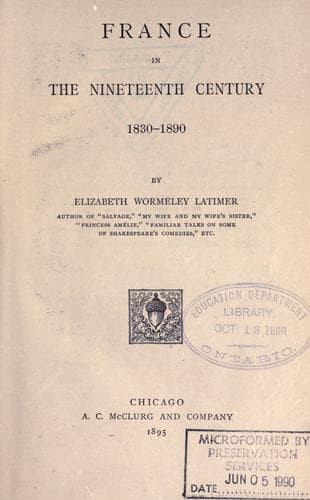
France in the Nineteenth CenturyLatimer, Elizabeth Wormeley
History
France in the Nineteenth Century
Latimer, Elizabeth Wormeley
France -- History -- 1789-1900
his chaplains, to the summit of the barricade. One of them had
his hat pierced by three balls, but the archbishop himself, almost
by a miracle, escaped while on the top. He had descended three
steps on the other side, when he was pierced through the loins by
a shot from a window. The insurgents, horror-struck, approached
him where he fell, stanched the wound, which at once was seen to
be mortal, and carried him to a neighboring hospital. When told
that he had only a few minutes to live, 'God be praised!' he said,
'and may He accept my life as an expiation for my omissions during
my episcopacy, and as an offering for the salvation of this misguided
people.' With these words he expired."
As soon as the archbishop's death was known, the insurgents made
proposals to capitulate, on condition of a general pardon. This
Cavaignac refused, saying that they must surrender unconditionally.
The fight therefore lasted until daybreak. Then the insurgents
capitulated, and all was over.
No one ever knew how many fell. Six generals were killed or mortally
wounded. Ten thousand bodies were recognized and buried, and it is
said that nearly as many more were thrown unclaimed into the Seine.
There were fifteen thousand prisoners, of whom three thousand died
of jail-fever. Thousands were sent to Cayenne; thousands to the
galleys. This terrible four days' fight cost France more lives
than any battle of the Empire.
The insurrection being over, and Cavaignac dictator, the next thing
was for the Assembly to make a constitution. This constitution was
short-lived. A president was to be chosen for four years, with
re-election as often as might be desired. He was to be elected by
universal suffrage. He was to have a salary of about one hundred
and twenty-five thousand dollars per annum, and he was to have
much the same powers as the President of the United States.
There were two principal presidential candidates,--Prince Louis
Napoleon, who had taken his seat in the Assembly; and Cavaignac,
who had the power of Government on his side, and was sanguine of
election. The prince proclaimed in letters and placards his deep
attachment to the Republic, and denounced as his enemies and slanderers
all those who said he was not firmly resolved to maintain the
constitution.
The result of the election showed Louis Napoleon to have had five
and a half millions of votes; Cavaignac one and a half million;
Lamartine, who six months before had been a popular idol, had nineteen
thousand.
[Illustration: _LOUIS NAPOLEON._ (The Prince President.)]
An early friend of Louis Napoleon, who seems to have been willing
to talk freely of the playmate of her childhood, thus spoke of
him to an English traveller.
Public-domain text, read in full here on John Shaqi.
Reviews
Reviews
No reviews yet
Be the first to share your thoughts on this work.
Elsewhere in the archive
Join the Discussion
Join the discussion
Sign in to leave a comment or review.
Sign InorCreate an account