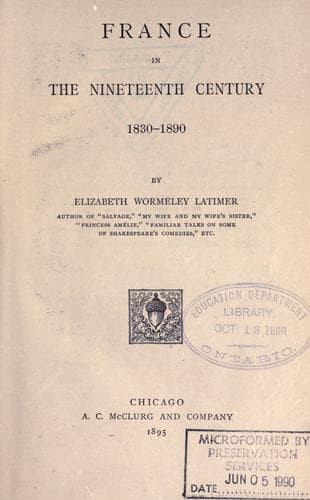
France in the Nineteenth CenturyLatimer, Elizabeth Wormeley
History
France in the Nineteenth Century
Latimer, Elizabeth Wormeley
France -- History -- 1789-1900
"He is," she said, "a strange being. His mind wants _keeping_.
A trifle close to his eyes hides from him large objects at a
distance.... The great progress in political knowledge made by
the higher classes in France from 1815 to 1848 is lost on him.
When we met in 1836, after three years' separation, I was struck
by his backwardness in political knowledge. Up to 1848 he never
had lived in France except as a child or a captive. His opinions
and feelings were those of the French masses from 1799 to 1812.
Though these opinions had been modified in the minds of the higher
classes, they were, in 1848, those of the multitude, who despise
parliamentary government, despise the pope, despise the priests,
delight in profuse expenditure, delight in war, hold the Rhine to
be our national frontier, and that it is our duty to seize all
that lies on the French side. The people and he were of one mind. I
have no doubt that the little he may have heard, and the less that
he attended to, from the persons he saw between 1848 and 1852 about
liberty, self-government, economy, the supremacy of the Assembly,
respect for foreign nations, and fidelity to treaties, appeared
to him the silliest talk imaginable. So it would have appeared
to all in the lower classes of France; so it would have appeared
to the army, which is drawn from those classes, and exaggerates
their political views."
"The prince president is romantic, impulsive, and _bizarre_," said
one of his officials to the same English gentleman, "indolent, vain,
good-natured, selfish, fearing and disliking his superiors;...
he loves to excite the astonishment of the populace. As a child
he liked best bad children,--as a man, bad men."
But one good quality he had pre-eminently,--no man was ever more
grateful for kindness, or more indulgent to his friends.
Such was the man, untried, uneducated in French politics, covered
with ridicule, and even of doubtful courage, whom the voices of
five and a half millions of French voters called to the presidential
chair. It was to the country Louis Napoleon had appealed, to the
rural population of France as against the dangerous classes in the
great cities. Paris had for sixty years been making revolutions
for the country; now it was the turn of the provincials, who said
they were tired of receiving a new Government by mail whenever it
pleased the Parisians to make one. Paris contained one hundred and
forty thousand Socialists, besides Anarchists and Red Republicans.
With these the rural population had no sympathy. Louis Napoleon was
not chosen by their votes, nor by those of their sympathizers in
other great cities. His success was in the rural districts alone.
Public-domain text, read in full here on John Shaqi.
Reviews
Reviews
No reviews yet
Be the first to share your thoughts on this work.
Elsewhere in the archive
Join the Discussion
Join the discussion
Sign in to leave a comment or review.
Sign InorCreate an account