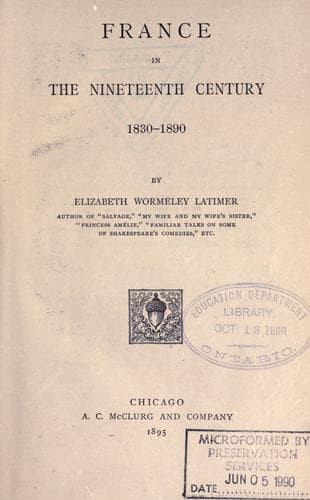
France in the Nineteenth CenturyLatimer, Elizabeth Wormeley
History
France in the Nineteenth Century
Latimer, Elizabeth Wormeley
France -- History -- 1789-1900
By the night of December 3 there was a good deal of commotion in
the city. Two days of disorganization, idleness, and excitement
had made workmen more inflammable than when they remained passive
under the appeals of Victor Hugo. The remainder of the story, so far
as it concerns the uprising and massacre in the streets of Paris,
I will borrow from the experience of an American eye-witness; but
first I will tell what happened to the African generals imprisoned
at Mazas.
On the night of December 3 the station of the great railroad to
the north was filled with soldiers. About six o'clock the next
morning two _voitures cellulaires_ drove up, each attended by a
light carriage containing an especial agent sent by the police.
These vehicles, just as they were, were rolled on to trucks, and
the train moved out of the station. There were eight cells in each
_voiture cellulaire_; four were occupied by prisoners, four by
policemen. It was bitterly cold, and in the second of the prison-vans
the police, half frozen, opened the doors of their cells and came
out to walk up and down and warm themselves. Then a voice was heard
from one of the prisoners. "_Ah, ça_, it is bitterly cold here.
Could n't one be allowed to re-light one's cigar?" At this another
voice called out: "_Tiens!_ is that you, Lamoricière? Good morning!"
"Good morning, Cavaignac," replied the other. Then a third voice
came from the third cell. It was that of Changarnier. "_Messieurs
les Généraux_," cried a fourth, "do not forget that I am one of
you." The speaker was a _quoestor_ of the Chamber of Deputies, a
man charged with the safety of the National Assembly. The generals
who had spoken, and Bedeau, who was in the next van, were, with the
exception of Bugeaud, the four leading commanders in the French
army. The other four prisoners were Colonel Charras, General Le
Flô, Baze the _quoestor_, and a deputy, Count Roger (_du Nord_).
At midnight they had been roused from sleep and ordered to dress
immediately. "Are we going to be shot?" asked Charras, but no answer
was vouchsafed him. They were put into the _voitures cellulaires_,
each knowing nothing of the presence of the others; even the police
who were in charge of them, had no idea what prisoners they had in
custody. After this recognition between the generals, they were
permitted to come out of their cells and walk up and down the van
to warm themselves, taking care, however, that they were not seen
at liberty by the special agents in the carriages attending on
each van.
On reaching Ham, the former prison of Louis Napoleon, Cavaignac,
whom he had succeeded as ruler of France, was put into his former
chamber. "Chassez croissez," said De Morny, when the report was
made to him.
Public-domain text, read in full here on John Shaqi.
Reviews
Reviews
No reviews yet
Be the first to share your thoughts on this work.
Elsewhere in the archive
Join the Discussion
Join the discussion
Sign in to leave a comment or review.
Sign InorCreate an account