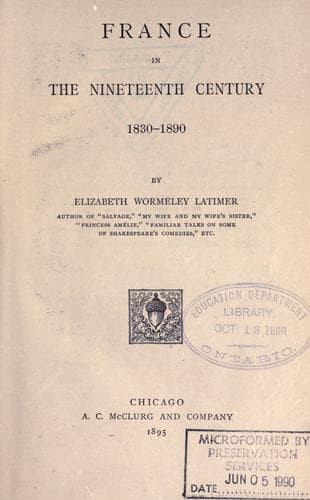
France in the Nineteenth CenturyLatimer, Elizabeth Wormeley
History
France in the Nineteenth Century
Latimer, Elizabeth Wormeley
France -- History -- 1789-1900
December 4, the last day of the struggle, was by far the most terrible.
Louis Napoleon, in spite of many benefits which France and the world
owe him, will never be cleansed from the stain that the outrages of
that day have left upon his memory. It may be said, however, that
the details of the _coup d'état_ were left to his subordinates,
and that probably both success and infamy are due in large part
to the flippant Morny.
It was a cold, drizzling day. Such barricades as had been built
were very slimly defended, and with no enthusiasm. The insurgents
were short of ammunition, nor did the troops attack them with much
vigor. In fact, the soldiers were but few, for all were being
concentrated on that part of the Boulevard where strangers do their
shopping and eat ices at Tortoni's. The programme for that day
was not fighting, but a massacre.
The American gentleman whose narrative I am about to quote, says,--
"On December 3 there was more excitement in the streets than there
had been on December 2. The secret societies had got to work. The
Reds were recovering from their astonishment. Ex-members of the
National Assembly had harangued the multitude and circulated addresses
calculated to rouse the people to resistance. On the 4th there was
not much stirring. The shops were closed. I went into the heart
of the city on business, where I soon found myself in the midst
of a panic-stricken crowd. The residents were closing their doors
and barricading their windows. Some said the Faubourgs were rising;
some that the troops were approaching, with cannon.
"Hearing there were barricades at the Porte Saint-Denis, I pushed
directly for the spot. The work was going on bravely. Stagings had
been torn from unfinished houses, iron railings from the magnificent
gateway; trees were cut down, street sheds demolished; carts, carriages,
and omnibuses were being triumphantly dragged from hiding-places
to the monstrous pile. There were not very many men at work, but
those who were engaged, labored like beavers. Blouses and broadcloth
were about equally mixed. A few men armed with cutlasses, muskets,
and pistols appeared to act as leaders; soon a search was made
in neighboring houses for arms. I was surprised to see how many
boys were in the ranks of the insurgents. They went to work as if
insurrection were a frolic. I shuddered as I thought how many of
them would be shot or bayoneted before night fell. The sentiments
of the spectators seemed different. Some said, 'Let them go ahead.
They want to plunder and kill: they will soon be taught a good
lesson.' Others encouraged the barricade-makers. One man, hearing
that I was an American, said with a sigh, 'Ah, you live in a true
republic!'
Public-domain text, read in full here on John Shaqi.
Reviews
Reviews
No reviews yet
Be the first to share your thoughts on this work.
Elsewhere in the archive
Join the Discussion
Join the discussion
Sign in to leave a comment or review.
Sign InorCreate an account