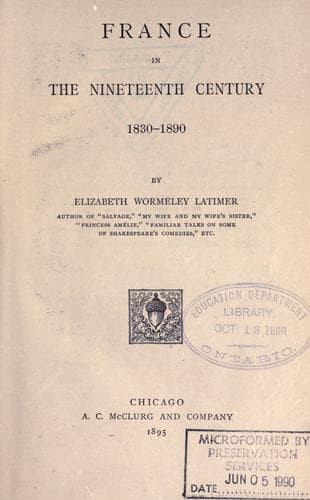
France in the Nineteenth CenturyLatimer, Elizabeth Wormeley
History
France in the Nineteenth Century
Latimer, Elizabeth Wormeley
France -- History -- 1789-1900
a cross-street I saw a well-dressed man gasping his life away on
a rude stretcher. Those around him told me he had six balls in
him. In the Rue Richelieu there was the corpse of a young girl.
Somebody had placed lighted candles at its head and feet. When I
reached the parts of the town removed from the surveillance of
the soldiers, I noticed a bitter feeling among the better classes
for the day's work. The slaughter had been amongst those of their
own class, which was unusual. The number slain was at first, of
course, exaggerated, but it was with no gratifying emotions that
we could reduce it a few hundreds. It was civil war,--fratricide.
I reached home indignant and mournful."
Victor Hugo says of the massacre: "There were no combatants on
the side of the people. There could not be said to have been any
mob, though the Boulevard was crowded with spectators. Then, as
the wounded and terrified rushed into houses, the soldiers rushed
in after them."
Tortoni's was gutted; the fashionable Baths of Jouvence were torn
to pieces; one hotel was demolished; twenty-eight houses were so
injured that they had next day to be pulled down. Peaceful shopkeepers,
dressmakers, and English strangers were among the slain,--an old man
with an umbrella, a young man with an opera-glass. In the house
where Jouvin sold gloves there was a pile of dead bodies.
The firing was over by four P. M. It has never been known how many
were massacred. Some said twenty-five hundred, some made it five
hundred, and almost every person killed was, not a Red combatant,
but an innocent victim.
Thus Louis Napoleon made himself master of Paris. The army was
all for him, the masses were apathetic, the rural population was
on his side. A few weeks later a _plébiscite_ made him emperor.
The _coup d'état_ having succeeded, most Frenchmen gave in their
adhesion to its author. It remained only to dispose of the prisoners.
Without any preliminary investigation, squads of them were shot,
chiefly in the court-yard of the Prefecture of Police. All deputies
of the Left were sent into exile, except some who were imprisoned
in Algerine fortresses or sent to Cayenne,--the French political
penal colony at that period.
Victor Hugo remained a fortnight in hiding, believing, on the authority
of Alexandre Dumas, that a price was set upon his head. He gives
some moving accounts of little children whom he saw lying in their
blood on the evening of the massacre. His chief associates nearly
all escaped arrest, and got away from France in various disguises.
Their adventures are all of them very picturesque, and some are
very amusing.
Several of the eight prisoners at Ham suffered much from dampness.
Lamoricière, indeed, contracted permanent rheumatism during his
imprisonment. He begged earnestly to be allowed to write to his
wife, but was permitted to send her only three words, without date:
"I am well."
Public-domain text, read in full here on John Shaqi.
Reviews
Reviews
No reviews yet
Be the first to share your thoughts on this work.
Elsewhere in the archive
Join the Discussion
Join the discussion
Sign in to leave a comment or review.
Sign InorCreate an account